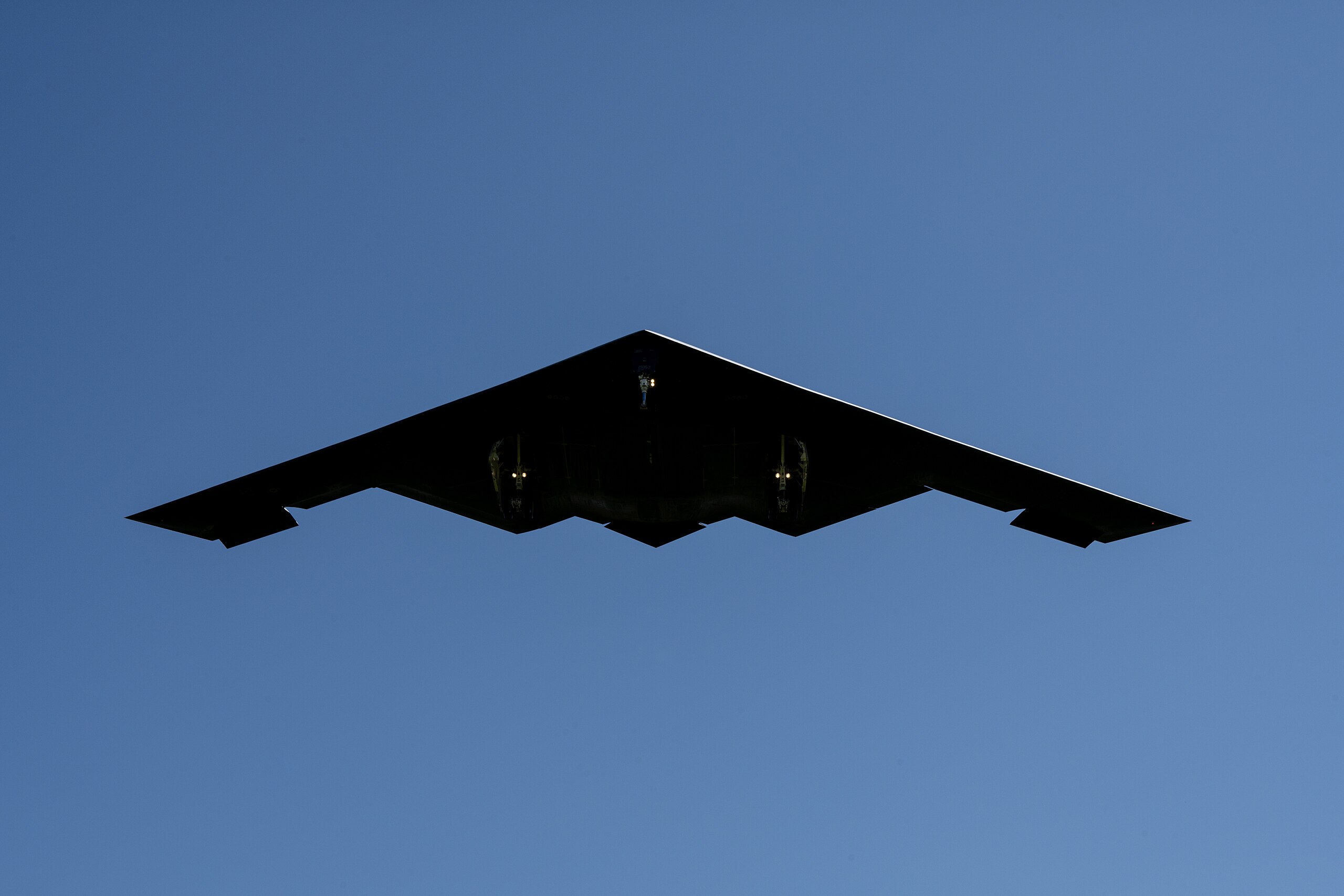
For years to come, historians will study the personalities, factors, and events that influenced Donald Trump’s decision to launch a massive airstrike against three Iranian nuclear facilities on the morning of June 22. It was one of the most intense geopolitical episodes in recent years, and the strike itself was every bit as “spectacular” as Trump claimed it was in his press conference late on June 21.
Paradoxically, the result of this overwhelming display of violence appears to be peace—or a ceasefire, at least. Since 1979, the Islamic Republic of Iran has been a rogue power acting with impunity against anyone who opposed its vision of a worldwide Shia revolution. But for the first time in over forty years, this rogue power has been stopped in its tracks. Its proxies are maimed or dead, its missile silos and nuclear facilities are in ruins, and most of its military leadership is dead. It’s an unprecedented and humiliating defeat, and a remarkable turn of events.
Unfortunately, the war between the Islamic Republic and Israel won’t end here—its roots are too deep. But quiet has been restored for now, and men and women have stopped dying, and that’s good enough. Ideally, this ceasefire will pave the way for a follow-on ceasefire in Gaza and an end to the larger war.
But before we lurch into another dizzying news cycle, let’s take a moment to learn the lessons of Operation Midnight Hammer. There are at least six.
1. Superior military power is the only way to make peace with a rogue regime.
For decades, Iran has been battling Israel and the US (“little” and “big” Satan, respectively), sometimes openly but always covertly. The heart of its strategy is to use a network of Arab militias to construct a “ring of fire” that will hem the Jews in against the Mediterranean Sea until they can be forced out or killed. The strategy has also included lethal activity against American personnel and interests in Iraq, Afghanistan, and the Gulf, and international terrorism around the world. Yet despite these provocations, Republican and Democrat presidents have shown remarkable restraint in their dealings with Iran and urged Israel to do the same. Our preference is always diplomacy. We strike back occasionally, but only in limited fashion.
This was a mistake. Diplomacy is worthwhile, but every round of diplomacy needs a firm deadline. Revisionist regimes founded on the rejection of certain enemies won’t make peace with those enemies without undermining their raison d’etre. Bush, Obama, Biden, and Trump fell for Iran’s lies and delay tactics for years, continuing our diplomacy while patiently absorbing attack after attack. We had overwhelmingly superior strength, but declined to use it.
Trump broke ranks with his predecessors when he realized—whether on his own or forced by events, history will tell us—that Iran would never give up its nuclear ambitions peacefully. Impressed by Israel’s rapid success in the early hours of Operation Rising Lion, Trump made a decision. Two decades of diplomacy was quite enough. He gave orders for his own strike, and the rest is history.
2. “Superior military power” doesn’t mean regime change.
Operation Midnight Hammer is the most controversial moment in Trump’s second term by far, revealing the size of the rift between Republican “restrainers” like Tucker Carlson and traditional conservatives like Ted Cruz on questions of military intervention. A recent Reuters/Ipsos survey found that 45 percent of Americans disapprove of Trump’s operation; just 36 percent support it. No one wants an Iranian regime change, and at this point the regime looks likely survive, though crippled in power and prestige.
I should be clear: millions of Iranians, Israelis, Arabs, and Americans want the Iranian regime to fall. People have imagined a free Iran ever since it was shackled by violent mullahs in 1979. On Monday, Reza Pahlavi, a Washington DC-based expat and son of the deposed shah, threw his hat in the ring as the ayatollah’s replacement, claiming a “100-day plan” that will move Iran from dictatorship to secular democracy. Trump and Netanyahu used regime change language during the operation, but mostly as a psyop against the ayatollah. No one is talking seriously about replacing the Islamic Republic by force. There is no “government in a box” for Tehran or enough political support to impose one.
Regime changes only succeed in two situations: when led organically from below or imposed from above through a long-term military occupation, or both. And even then, what follows is unpredictable and violent. Bloody aftershocks may ripple for years to come.
The Crown Prince and the Iranian people reserve the right to seize control of their country in a moment of regime weakness, but neither America nor Israel can do it for them. Nor should they. If the people rise up, the US may help; but no one in this administration is going to push it. The Iranian regime will fall, but it will happen when it happens. In the meantime, our war goals have been accomplished and a better power equilibrium is emerging. Amen.
3. Massive yet targeted use of force is often enough to break a bold enemy.
There’s a great scene in the movie Tombstone (1993) when Wyatt Earp (Kurt Russell) stands up to a loudmouthed bully named Johnny Tyler (Billy Bob Thornton) who has intimidated a hotelier, his patrons, and his gambling business. After sizing the pudgy thug up and down, Earp walks over to him and dresses him down before slapping him hard across the face, daring him to reach for his pistol. “Go ahead, skin it,” Earp growls menacingly at Tyler. “Skin that smoke wagon and see what happens.” The hapless thug, bleeding and scared, lowers his head and does nothing. Earp grabs him by the ear and tosses him out.
It’s a good way to visualize the psychological effect that the American-Israeli slap had in Tehran. Until Saturday, Trump’s 2019 airstrike on Qassem Soleimani was the premier example of the “Tombstone slap.” But Midnight Hammer is now the best case study in how to “escalate to de-escalate,” and will be so for awhile. For forty-plus years the ayatollahs and their minions have been loudmouthed bullies on the world stage, cursing and threatening their enemies and oppressing their people. Pundits and policymakers have long avoided confronting this bully, fearing the outbreak of an Armageddon-like war that could engulf the world; instead, they advised appeasement and renewed goodwill. But 12-days of Israeli-American military might exposed the ayatollah as nothing but a pudgy thug easily cowed by someone with greater strength and will. Out-bullying a bully is always the best way to stop one. The trick is to see through his bravado and slap him—hard—because a good slap today is better than a shootout tomorrow.
4. Military strikes don’t bring peace, but they restrain violent men for a while.
One of the keys to designing and “dosing” a military intervention is to limit its goals to what’s achievable. It should be obvious by now, but “bringing peace to the Near East” is not on a list of such goals. God willing, Jacob will make peace with Ishmael—but it will happen when it happens. One must modulate his hopes accordingly. Rather than peace, the goal is a better equilibrium between the region’s rival powers. “Peace” in the full meaning isn’t necessary, or even possible.
The durability of the latest ceasefire will be clear soon enough. Perhaps it will hold for decades like the 1949 armistice between Israel and the Arab states, or perhaps Iran will violate it, either immediately or eventually, openly or through its proxies. Perhaps the ayatollah will simply restart his nuclear program; perhaps Iran’s proxies trigger new conflicts as they vie for new sources of support; or perhaps Turkish President Recep Tayyip Erdogan and his Sunni Arab allies moves to fill the vacuum.
In the US, political blowback from Midnight Hammer could create a crisis within the Republican Party, shaping the midterm elections and sparking a season of conservative infighting and opportunities for the Democrats.
All of this can happen and more. Every solution contains the seeds of new problems. Midnight Hammer is no exception. But we’ll cross those bridges when we get to them, and thanks to Midnight Hammer, they’re farther than ever.
5. Forge deep alliances—and stand by them.
For Americans, Midnight Hammer was an impressive but limited airstrike that started and ended in hours and days. For Israelis, it was only the final act of a longer operation called Rising Lion which started on June 13; and Rising Lion itself is just the final act of a larger war that started on October 7, 2023. It’s been exhausting and demoralizing. But it’s been worth it, and not just for Israelis.
Still, Israelis have borne the greatest risk and bled the most blood to make Iran’s defeat possible. It was Israeli generals and intelligence officers who spent decades preparing for this conflict, and thousands of brave soldiers who took the fight against our shared enemies. It was Israeli courage, creativity, and resolve that ensured the definitive outcome of Midnight Hammer. And without Israel, it wouldn’t have been possible—and certainly at such minimal cost and effort.
We may have destroyed Fordow, but Israel is the hero of this story. And we know have a fresh new example of how strong values-based alliances remain vital even in—and perhaps especially in—seasons of greater American restraint.
The outcome, of course, is better than anyone could have predicted. Israel’s enemies (and ours) have been pushed back on every side: in Gaza, Lebanon, Syria, Yemen, and Iran. It’s a drama no less impressive than the Six Day War, just played out in slow motion. Immense death and damage has been unleashed in countries around the region. Great physical and psychological damage has been wrought on Israeli society, and some 50 hostages are still in Gaza. But even factoring in these adverse effects and any future aftershocks, this victory is momentous—and for America as much as for Israel.
6. It is good to give thanks to God.
Trump isn’t a religious man, but seems to respect religious people and even evinces a visible, if minimal, fear of God on occasion. One of those occasions was on Saturday night. It was entirely proper, indeed moving, when Trump, toward the end of his press conference, thanked American and Israeli soldiers and briefly paused. “I want to just thank everybody, and in particular God—,” he said, his voice faltering. “I want to just say we love you God…” It was interesting to hear a president make such a statement in the first person. And although I’m no body language expert, I saw a real look of gratitude on Trump’s face. I can only imagine the intensity involved with making huge decisions in the midst of such a crisis.
Of course, giving thanks to God is no guarantee that our will is synched with his. We can’t know his plans, nor should we try to impose whatever we think they are by force. But it would behoove leaders of both parties to offer such simple declarations of thanks on a regular basis—thanks, that is, to the supernatural being most Americans believe in. Gratitude, like charity, covers a multitude of sins.
“Iran, the bully of the Middle East, must now make peace,” Trump declared, and now some version of that peace appears to be taking hold. The next few weeks and months will determine how long it lasts, but we can be grateful in the meantime. The “destruction of Israel” clock in Tehran has been destroyed, along with the confidence of the monster that built it. And for that, we can be grateful.