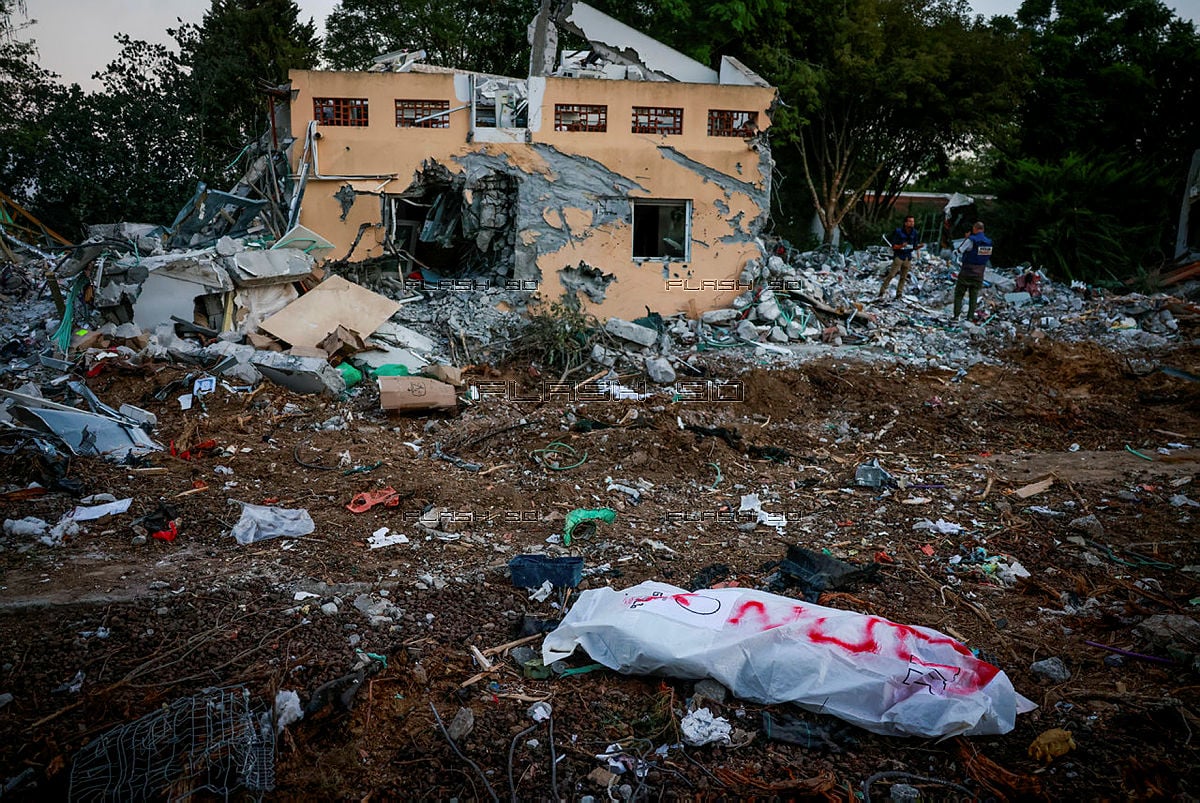
Antisemitic conspiracy theories promote claims that October 7 was false flag operation by Israel, with study showing denials of recent violence against Jews borrowing from classic Holocaust denial narratives.
By World Israel News Staff
Antisemitic social media accounts are applying tactics used by Holocaust deniers to contemporary acts of violence against Jews such as October 7, a report by a watchdog group warns.
On Monday, the CyberWell social media monitor said it has tracked the growing phenomenon of October 7 denialism and conspiracy theories promoting claims that the invasion of Israel which left 1,200 people dead was a “false flag” operation conducted by Israel as a pretext for an operation in the Gaza Strip.
The report, issued ahead of International Holocaust Remembrance Day, found that viral denial and conspiracy narratives targeting Jews on social media frequently recycle tactics historically associated with Holocaust denial and distortion.
According to the CyberWell report, online discourse following violent attacks against Jews and Israelis since October 7, 2023 has often shifted toward questioning the reality of the attacks, disputing documented evidence, or attributing responsibility to Jewish victims themselves.
CyberWell said these patterns resemble long-standing mechanisms of Holocaust denial, including erasing victimhood, inverting responsibility, and replacing established facts with conspiracy theories.
The analysis is based on real-time alerts and reports CyberWell submitted to major social media platforms over the past year, documenting recurring patterns that emerge after antisemitic attacks.
The report identified two dominant and interconnected narratives: denial, which portrays attacks as fabricated, exaggerated, or staged; and what CyberWell terms “Conspiratorial Self-Victimization,” in which Jews are accused of orchestrating or provoking violence against themselves to gain sympathy, political leverage, or public support.
CyberWell said these narratives echo classic antisemitic tropes that depict Jews as manipulative actors and contribute to the distortion of responsibility for violence. The organization warned that such rhetoric normalizes suspicion toward Jewish victims and undermines accountability for antisemitic attacks.
The report analyzed online content posted across Facebook, Instagram, TikTok, X, and YouTube following antisemitic attacks worldwide. The dataset included more than 300 examples of content that collectively generated nearly 14 million views and over 500,000 user interactions.
According to the findings, 88% of the posts analyzed featured claims asserting that Jews staged, provoked, or carried out violence against themselves, often alongside explicit denial of the attacks. In many cases, incidents were simultaneously labeled as hoaxes and described as coordinated “false flag” operations.
Nearly half of the content examined—47.4%—focused on denial or conspiratorial narratives related to the October 7 massacre, the deadliest single day for Jews since the Holocaust. CyberWell found that more than two years later, these narratives continue to circulate widely online, with only 17.8%of such content removed despite extensive documentation of the attacks.
“By analyzing the online response to the repeat violence targeting the Jewish community across the world in the last two years, this research reveals an important development in current Jew-hatred: denialism is being repackaged for the masses online,” said CyberWell Founder and CEO Tal-Or Cohen Montemayor.
“The current denial narratives that go so far as to blame Jews for orchestrating attacks against themselves draw directly on the framework of Holocaust denial and distortion. Violence against Jews is denied, responsibility is inverted, and conspiracies replace facts.”
“Whether it is the Holocaust or October 7 or other recent violent attacks against Jews, denial of well documented attacks against Jews is meant to dehumanize them further by erasing their victimhood—now at digital speed and global reach.”
The report concluded that social media platforms inconsistently address denial and conspiratorial narratives linked to contemporary antisemitic violence. While most major platforms explicitly prohibit Holocaust denial and distortion, CyberWell said similar narratives related to current events are enforced less consistently.
Platform-level analysis identified X as the largest source of both volume and user engagement for denialist and conspiratorial content. Across platforms, fewer than one in five reported posts were removed, even when CyberWell said they violated existing policies.
TikTok was identified as a partial exception due to community guidelines that explicitly prohibit denial of well-documented violent events and related conspiratorial narratives. However, CyberWell said enforcement on TikTok remained limited and below average removal rates for antisemitic content, highlighting what it described as the need for stronger and more consistent moderation across platforms.
The post Online antisemites applying Holocaust denial tactics to October 7 appeared first on World Israel News.