As US power declines, it is destroying the norms and institutions that once organized its international projection of authority. While the US is losing its leadership role, no single power is replacing it as a global hegemon.
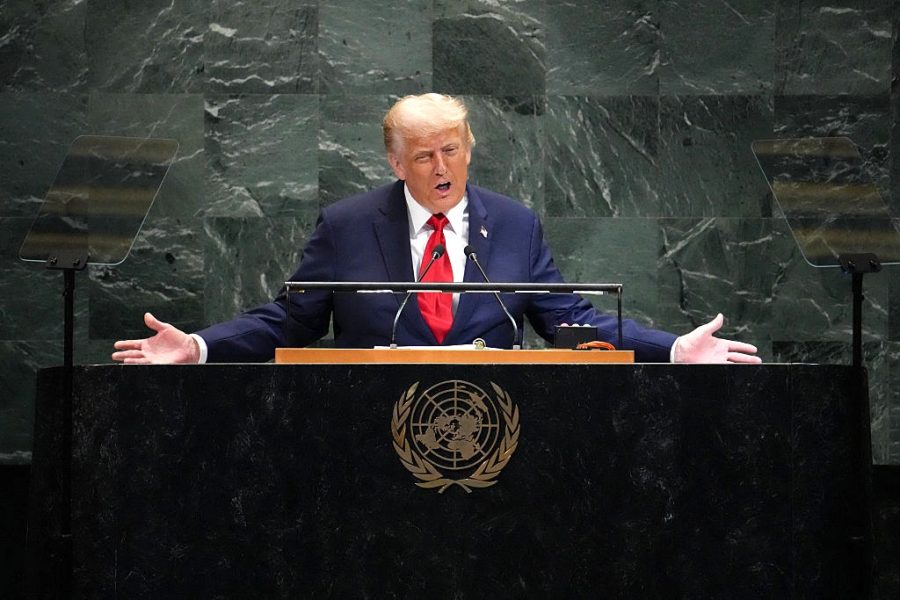
If there was still any doubt about our coordinates after a decade of shocks to the normal order of things, the disorientating opening of this year has confirmed that we are not in Kansas anymore. A new geopolitics is taking form, particularly evident in the ongoing US-Israeli bombardment of Iran, in the US abduction of Nicolás Maduro from Venezuela, and in the positioning of European troops in Greenland following Donald Trump’s claims on the island.
Since the financial crisis of 2007–8, incipient challenges to the primacy of US power, as well as political turbulence within Western capitalist democracies, have provoked the production of a considerable body of angsty writing about the end of things. Much of this writing, as it pertains to the imperial situation now commonly referred to as “international order,” expresses the desire for a “return” to stability.
It’s perhaps unsurprising, then, that so many commentators on international affairs, of different political allegiance, have repeated the famous statement on “interregnum” authored by Italian communist Antonio Gramsci: a period in which “the old is dying and the new cannot be born.”
Today such anticipation of “the new” in the international system tends to betray a pursuit of partial restoration of “the old,” premised on the idea that order can be a product of the will, of the kind of moral entrepreneurship exercised in previous decades by the cadres of global civil service and the executives of aid agencies and financial institutions. But there is no guarantee that a new order will be established.
The concept of international order, as it is generally understood today, describing a global arrangement of governing norms and institutions, is a bequest of the twentieth century, and more specifically of the period of US hegemony. In fact, while usage of this concept increased steadily in the second half of the twentieth century, it spiked dramatically over the last decade and a half, in precisely the moment of putative collapse of international order.
But it’s worth exploring Gramsci’s argument a bit more closely. In his thinking, order depends upon hegemony: that is, it depends not only, or primarily, on coercion but on “spontaneous consent.” The interregnum, he argued, is precisely a moment of hegemonic crisis, produced by a loss of authority and “leadership” that leaves only domination. Though Gramsci was concerned with the means through which the ruling class reproduces its power, his definition of hegemony has often been applied to international relations.
If the international order consolidated in the aftermath of World War II has now come to an end, it is because consent for US empire has broken down. American hegemony derived from a material structure: initially from the development of an unparalleled industrial base that enabled its projection of economic and military power; and then from the transformation of global trade and finance into mechanisms for the reproduction of this power.
This material structure produced an international complex of dependencies upon US empire, which, in turn, nurtured consent to its global leadership among other states and their ruling classes. If they were partially shaped by struggles “from below,” institutions of global governance — those of the United Nations, most obviously — were conditioned by US authority and a sufficient consensus with respect to it. However, the material structure of American hegemony no longer exists.
In pursuit of new opportunities for profit, US capitalism evolved over the last quarter of the twentieth century into a neoliberal regime of asset appreciation, partly through deregulation and financialization. Significantly increasing the value of the dollar, high interest rates in the United States provoked an explosion of global debt, cutting short import-substitution industrialization across much of capitalism’s periphery. However, they also accelerated the offshoring of American industry and created opportunity for the rise of national competitors to the United States, among which China eventually emerged as the most important. This competition then fragmented the authority of the United States itself.
Conducted without any attempt to formulate a coherent pretext, the attack on Venezuela by the United States provided perhaps the clearest demonstration to date that it is prepared to exercise coercion without consent, or, in the words of Indian historian Ranajit Guha, “dominance without hegemony.” Neither the overextension of US empire through warmaking nor the exhaustion of its propaganda is primarily responsible for the crisis of its hegemony. Rather, the main cause is its creation of conditions for economic challenges to its pursuit of global power, a contradictory consequence of its expansion.
Amid the ruins of the old order, however, it is far from clear how the material structure able to sustain a new one might take form. US empire retains much of its might, with the unmatched budget and reach of its military, the global reference of its currency, and the market dominance of its biggest firms. Any prospect of subordinating it in a system instead ordered by Chinese hegemony seems inconceivable without a direct and large-scale military confrontation, involving the possible use of nuclear weapons. And, for all the features that distinguish the Chinese regime of accumulation from US capitalism, it is increasingly suffering from similar pathologies: falling productivity and demand, along with deflationary pressures, suggestive of a secular stagnation exacerbated by industrial overcapacity, rising debt, and a rapidly aging population.
It seems likely, then, that we are now entering a time after order, a time of enduring hegemonic crisis. Some might read this situation as a revival of the status quo ante, since, in the long sweep of modern history, the American century was exceptional for the global extent of hegemony exercised by a leading power. However, contrary to the emerging common sense, this does not imply return to a geostrategic dispute managed through “spheres of influence” — a legalistic arrangement associated with the late nineteenth century, through which colonial powers divided mostly distant territories.
There is no pact of noninterference between the United States and China; and, while both will most forcefully assert primacy over their respective regions, neither will manage to expel the other.
The world after order is giving form to a “zonal geopolitics,” in which different terms of great-power dispute will likely prevail across different geographic zones. This is a more unstable and dangerous interimperial arrangement, and it has significant implications for international governance and cooperation. Those rightly concerned with developing international institutions to protect sovereignty and constrain empire might be well-advised to focus their efforts regionally and on the formation of blocs that can compel great powers to moderate pursuit of their own particularist interests.