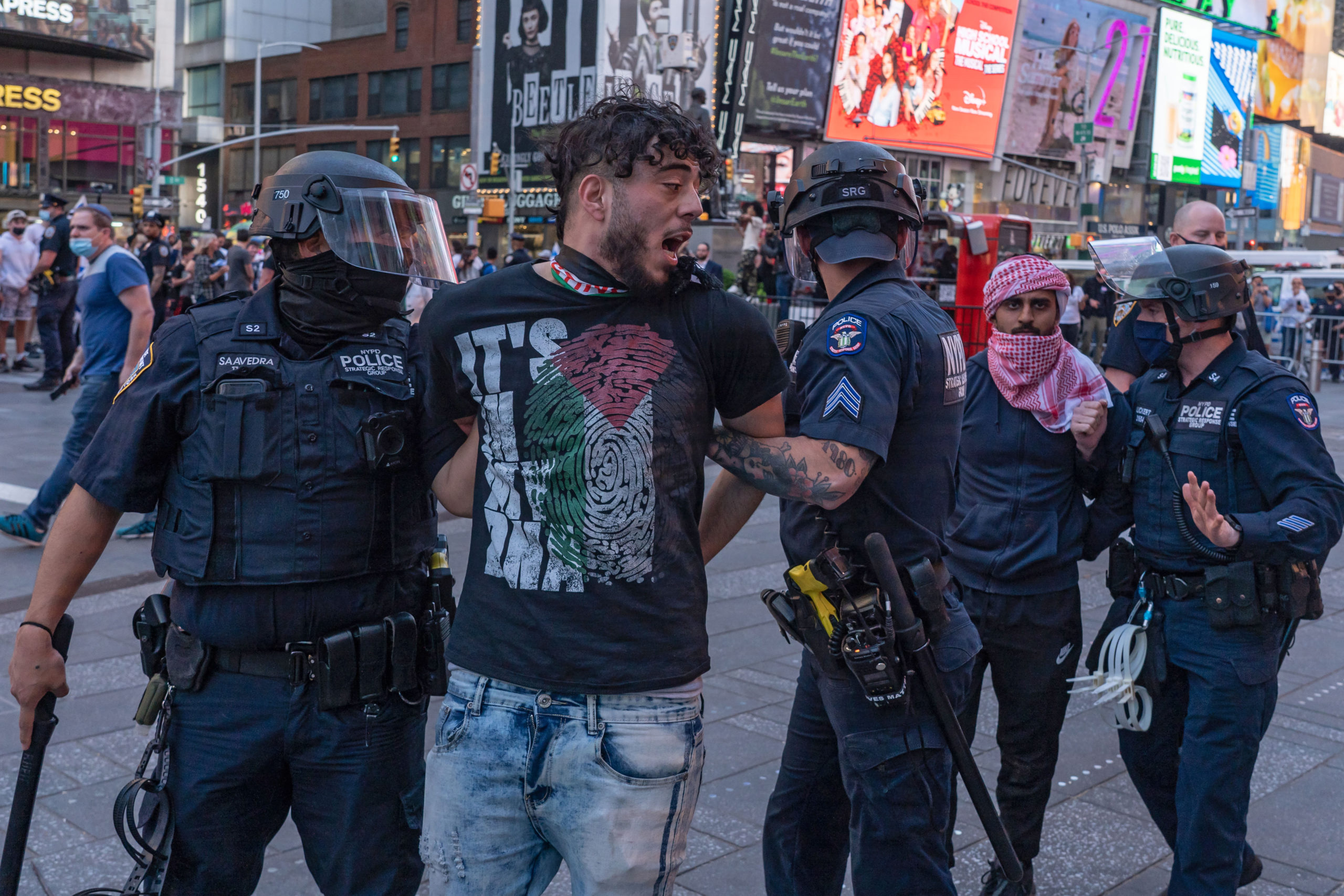
From 2013 to 2024, Students for Justice in Palestine, pro-Hamas faculty groups, and others posted over 76,000 posts on social media, with over half, 54.9 percent, including only a single, evocative image.
By Dion J. Pierre, The Algemeiner
Anti-Israel groups on college and university campuses in the US employ an array of methods for spreading their extremist worldview and coercing higher education institutions into adopting it, according to a new report published by the Institute for the Study of Contemporary Antisemitism at Indiana University, Bloomington.
Shared with The Algemeiner, the report — titled “Anti-Israel Campus Groups: Online Networks and Narratives” — explores the ways in which pro-Hamas student groups draw in the world beyond the campus to heighten pressure on university officials and create an illusion of inexorable support for anti-Zionism.
Key to this effort, the report explains, is a vast and ambitious network of non-campus anti-Israel organizations which ply them with logistical and financial resources that significantly boost their capabilities beyond those of normal student clubs.
“Social media platforms, particularly Instagram, play a critical role in mobilizing these groups, spreading radical narratives, and coordinating actions at both local and national levels,” report authors Gunther Jikeli and Daniel Miehling write.
“Social media shapes perceptions of the Israel-Hamas conflict in significant ways, often through highly emotive and polarizing content that fuels activism and, at times, incitement.”
They continue, “Organizations such as NGO Monitor have highlighted the critical role played by the WESPAC Foundation and off-campus groups like the Palestinian Youth Movement (PYM), which maintain documented ties to the US-designated terrorist organization, the Popular Front for the Liberation of Palestine (PFLP).
These groups not only influence campus activism but also help disseminate extremist rhetoric that is difficult to distinguish from that promoted by terrorist organizations.”
Social media platforms, which have modernized the manufacturing and distribution of political propaganda by reducing complex subjects to “memes” — some involving humor or contemporary cultural references which appeal to the sensibilities of the youth — are the cheapest and most effective weapons in the arsenal of the pro-Hamas movement, the report explains, adding that this was true before the Palestinian terrorist group’s Oct. 7, 2023, massacre across southern Israel precipitated an explosion of anti-Israel activity online.
However, extremist groups have been pushing such anti-Israel activism on campuses long before the Oct. 7 atrocities, according to the report.
From 2013 to 2024, Students for Justice in Palestine, pro-Hamas faculty groups, and others posted over 76,000 posts on social media which were analyzed by the Institute for the Study of Contemporary Antisemitism. Over half, 54.9 percent, included only a single, evocative image.
“In contrast, Reels (5.3%) and Videos (4.9%) are used far less frequently,” the report says. “Based on these descriptions, we see a strong preference among campus-based anti-Israel groups for static visual formats, suggesting that this type of bimodal content represents the highest form of shareability within activists networks.”
To boost their audience and reach, pro-Hamas groups also post together in what Jikeli and Miehling describe as “co-authored posts,” of which there were over 20,000 between 2013 and 2024.
The content they contain elicits strong emotions in the individual users exposed to it, inciting incidents of antisemitic discrimination, harassment, and violence, the report continues.
Such outrages increase in proportion to the concentration of anti-Israel groups on a single campus, as the report’s data show a relationship that is “particularly strong.”
“Universities with a high number of recorded antisemitic incidents tend to have a large number of active anti-Israel groups on their campuses,” the report states. “Antisemitic incidents correlate with the number of anti-Israel groups active on campuses.”
Antisemitic incidents on campuses surged immediately following the Hamas-led Oct. 7 onslaught, with the average number of antisemitic incidents spiking from 4.5 per day in early October 2023 (Oct. 1–6) to over 20 incidents per day between Oct. 7 and 26, just before the start of Israeli military’s ground offensive in Gaza.
Such incidents also skyrocketed during the wave of so-called “Gaza Solidarity Encampments” in April and May 2024.
Of all the groups responsible for fostering a hostile campus environment, Students for Justice in Palestine (SJP) stands out for being “the most frequent collaborator with other anti-Israel organizations,” the report adds.
The group’s closest ally appears to be the Palestinian Youth movement, which maintains ties to PFLP, an internationally designated terror organization which became infamous in the 20th century for perpetrating a series of airplane hijackings.
“This close collaboration not only broadens SJP’s audience but also suggests that PYM’s radical anti-Zionist rhetoric and visual language may shape elements of SJP’s discourse,” Jikeli and Miehling explain.
“PYM’s posts frequently incorporate imagery associated with socialist iconography, national liberation movements, and Islamist martyrdom. Such content often features slogans that reject the legitimacy of the Israeli state, depict convicted Palestinian terrorists imprisoned in Israel as political prisoners, and glorify members of terrorist groups.”
Jikeli and Miehling, who plan to release more findings in the near future, conclude that university officials, as well as policy makers, are obligated to respond now, not later, to the campus antisemitism crisis.
“Ensuring the safety and inclusion of Jewish students should become a critical component of diversity and inclusion efforts, alongside clear guidelines that distinguish legitimate political discourse from hate and incitement,” they say.
As previously reported by The Algemeiner, the anti-Zionist campus group Faculty for Justice in Palestine (FJP) is also fueling antisemitic hate crimes, efforts to impose divestment on endowments, and the collapse of discipline and order on college campuses, according to a “groundbreaking” study, titled “Academic Extremism: How a Faculty Network Fuels Campus Unrest,” that antisemitism watchdog AMCHA Initiative published during the start of the 2024-2025 academic year.
A faculty spinoff of SJP, a group with numerous links to Islamist terror organizations, FJP chapters have been established on colleges since Hamas’s Oct. 7 massacre across southern Israel.
Since the 2023-2024 academic year, its members, which include faculty employed by the most elite US colleges, have fostered campus unrest, circulated antisemitic cartoons, and advocated severing ties with Israeli companies and institutions of higher education.
AMCHA Initiative said that its presence throughout academia is insidious and should be scrutinized by lawmakers.
Using data analysis, AMCHA Initiative said it discovered a correlation between a school’s hosting an FJP chapter and anti-Zionist and antisemitic activity.
For example, the researchers found that the presence of FJP on a college campus increased by seven times “the likelihood of physical assaults and Jewish students” and increased by three times the chance that a Jewish student would be subject to threats of violence and death.
FJP also “prolonged” the duration of the Spring 2024 “Gaza Solidarity Encampment” protests on college campuses, in which students occupied a section of campus illegally and refused to leave unless administrators capitulated to demands for a boycott of Israel.
The report said that such demonstrations lasted over four and a half times longer where FJP faculty were free to influence and provide logistic and material support to students.
Professors at FJP schools also spent 9.5 more days protesting than those at non-FJP schools.
“Our investigation alarmingly reveals that campuses with FJP chapters are seeing assaults and death threats against Jewish students at rates multiple times higher than those without FJP groups, providing compelling evidence of the dangerous intersection between faculty activism and violent antisemitic behavior,” AMCHA said at the time.
“The presence of FJP chapters also correlates with the extended duration of protests and encampments, as well as with the passage of BDS resolutions on their campuses.”
The post Anti-Israel campus groups resourceful in finding ways to harass Jewish students, report shows appeared first on World Israel News.