In the West Bank village of Umm al-Kheir, a football pitch is named after Awdah Hathaleen, a local man murdered last summer by an Israeli settler. Now Israel has issued an order to destroy the pitch, as part of its continual ethnic cleansing of the West Bank.
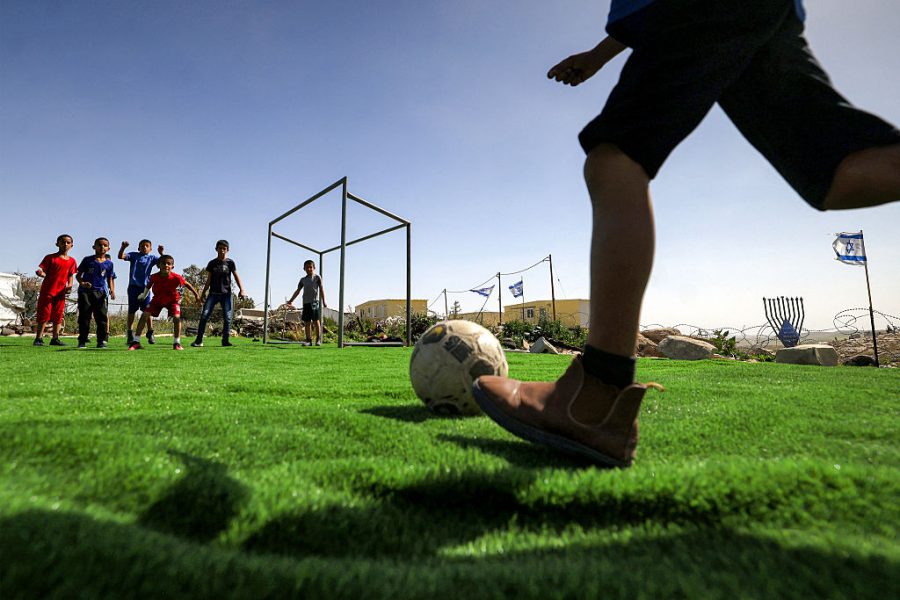
At the edge of the Israeli settlement of Carmel, which cleaves the Palestinian village of Umm al-Kheir in two, a football pitch now stands in memory of Awdah Hathaleen. It is a rough rectangle of compacted earth, bordered by wire fencing and crooked metal posts hammered into the ground. Awdah Hathaleen was killed on July 28, 2025, in this village, Umm al-Kheir, in the southern reaches of the occupied West Bank. The Israeli settler Yinon Levi shot him at close range; the bullet tore through his lungs. Awdah died with a camera in his hand, filming what had become an almost routine event in his village: another settler incursion. Awdah was a teacher, an activist, and the father of three children.
Like many families in the area, his relatives had been expelled from the Naqab desert during the Nakba of 1948 and had eventually settled in the rugged hills south of Hebron. Over the years, Awdah became one of the most visible figures of nonviolent resistance in the region. He documented settler violence, accompanied international delegations through the villages of the South Hebron Hills, and worked alongside Palestinian, Israeli, and international activists to shield his community from demolitions, land confiscations, and the daily strains of colonial rule.
Umm al-Kheir lies in the area known as Masafer Yatta, within Area C of the occupied West Bank. Covering roughly 60 percent of the West Bank, Area C is that part of its territory that, under the Oslo Accords of 1993–94, was meant to pass gradually into Palestinian administration as part of a future state. Instead it remains under full Israeli military and administrative control. Masafer Yatta is a landscape of wind-scoured hills dotted with around twenty small Palestinian shepherding communities. Families here live mostly from herding and subsistence agriculture, often in villages lacking even the most basic infrastructure.
In the 1980s, the Israeli army declared large swaths of this region a military training ground, the so-called Firing Zone 918. Since then, the communities living here have existed under a constant shadow of expulsion. Most villages have no master plan recognised by the Israeli authorities. As a result, almost any structure — a home, a water cistern, a solar panel, a sheep pen — can be declared illegal and demolished. Water access is sporadic, and electricity is scarce or absent.
For more than two decades, residents of Masafer Yatta challenged the army’s plans before the Israeli courts, with legal support from Israeli human rights lawyers and organizations, including the Association for Civil Rights in Israel. In May 2022, the Israeli Supreme Court rejected the petitions against the military’s closure of Firing Zone 918, effectively allowing the eviction of more than one thousand Palestinian residents from Masafer Yatta, in what many human rights organizations described as “one of the largest single forced displacements of West Bank Palestinians” since the occupation began in 1967. The slow violence running through these communities’ existence reached international audiences through the Oscar-winning documentary No Other Land, directed by the Israeli Yuval Abraham and the Palestinian Basel Adra. Awdah Hathaleen took part in the making of the film and was one of the people who made the story possible.
Khalil Hathaleen, Awdah’s brother, stands at the edge of the football pitch built in his memory, tapping a ball against his foot on the dusty ground as he speaks: “After Awdah was killed, I was arrested together with other members of the community. Awdah’s body was withheld by the authorities for almost ten days. They wanted to force us to bury him in a private funeral. But we are not criminals. Why couldn’t Awdah have a proper burial?”
For days after the killing, Awdah’s body was not returned to the family. As the delay stretched on, the women of Umm al-Kheir launched a hunger strike led by Awdah’s wife, Hanadi Hathaleen, demanding the right to bury him with dignity. Only then, after mounting pressure, was the body finally released. When the funeral was eventually allowed to go ahead, hundreds of residents, joined by a small group of activists, accompanied Hathaleen on his final journey from the mosque to the cemetery. It was a silent procession, but one tightly controlled from beginning to end. At least three checkpoints were set up between the main road and the cemetery, and the entrance to Umm al-Kheir remained sealed for hours afterward, preventing mourners from reaching the family to offer condolences.
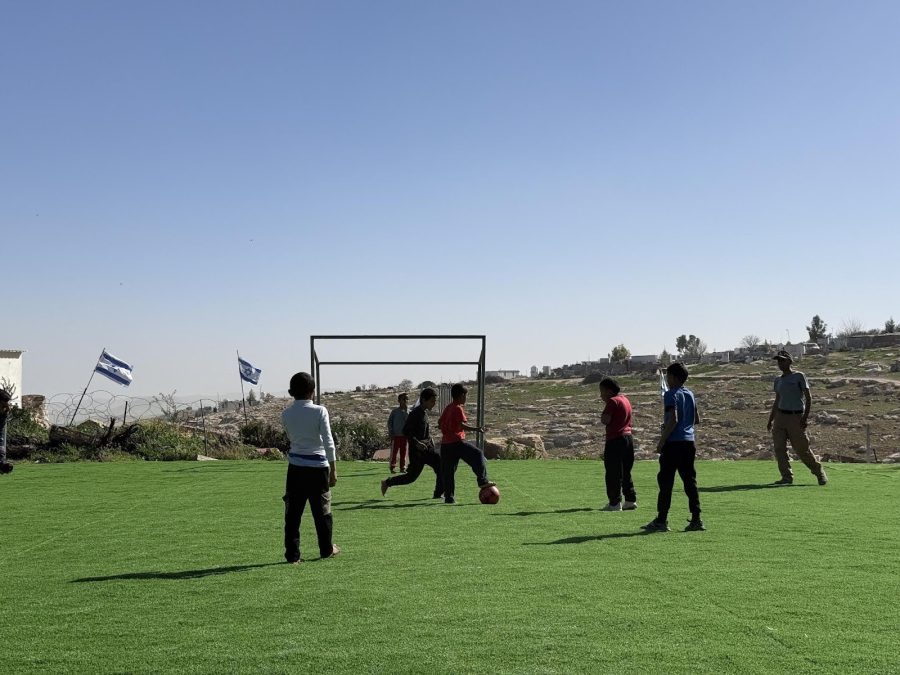
“Life has lost its color since they took Awdah away from us. What keeps me alive is continuing the path he began. With the help of Israeli and international activists, we managed to build this football pitch for the children of the community.” Khalil’s eyes move across the bare field. “It was a project Awdah cared about deeply. But only a few days after it was built, Israeli forces pinned a demolition order to its gate.” The notice was delivered on February 10, 2026, placing even this small patch under threat. Just a month earlier, the Israeli military had threatened to demolish the football pitch in Aida refugee camp, by Checkpoint 300 on the edge of Bethlehem, which separates the city from Jerusalem. Following a large solidarity campaign and the intervention of the Union of European Football Associations’ president Aleksander Čeferin — alongside pressure from FIFA — the demolition order was rescinded, at least for now.
“What threat can a football pitch possibly pose?” Khalil asks quietly. “Meanwhile, his killer, Yinon Levi, is still free. He comes here almost every day to intimidate our community, which is still mourning. If he had killed a dog, the consequences would have been more severe.”
Yinon Levi is the founder of the Meitarim Farm outpost, one of several settler enclaves that have appeared in recent years across the South Hebron Hills. Because of his involvement in violence against Palestinians, he had been sanctioned by the Biden administration in the United States on February 1, 2024, by the United Kingdom on February 12, by the European Union on April 19, and by Canada on May 16; France later adopted similar measures the same year. Those US sanctions were effectively undone on January 20, 2025, the very day Donald Trump returned to the White House; Levi’s name was formally removed from the sanctions list four days later. After killing Awdah Hathaleen, Levi spent only a few days under house arrest before returning to intimidate the community of Umm al-Kheir. On February 26, 2026, Israeli prosecutors announced their intention to charge him with reckless homicide, an offense carrying a maximum penalty of twelve years’ imprisonment. No final judgment has yet been issued. According to figures compiled by the Israeli human rights groups B’Tselem and Yesh Din, roughly 93 percent of investigations into settler violence against Palestinians are closed without indictment, and only around 3 percent result in a conviction.
As Khalil speaks, Eid Suleiman, a nonviolent activist from Umm al-Kheir, approaches the edge of the football pitch. He was also arrested after Awdah’s killing and held in Ofer Prison near Ramallah. He gestures toward the field. “We are only trying to give our children a dignified life. As soon as we built this field, soldiers and police arrived. They accused us of illegal construction. But this is not a building. It is simply a piece of land where children can play.” For Eid, the pattern is unmistakable. “They build new outposts. They take more land. They intimidate the people who live here. They want to make life impossible for Palestinians. They don’t expel you directly. They make it impossible for you to remain. We know this strategy very well. It is part of the project to annex the West Bank. The goal is to annex Area C and push Palestinians into the surrounding Area A.” Two years ago, Eid’s own house was demolished. “The court ordered it,” he adds. “I lost my home. My children saw everything.”
The deterioration of conditions in the West Bank since October 7, 2023, has been documented by dozens of human rights organizations. B’Tselem has warned that the regional escalation risks accelerating the process of colonization in the territory, describing the current moment as one in which violence by settlers, military restrictions, and land seizures increasingly operate in tandem. In several reports published over the past year, the organization has argued that the cumulative effect of these policies amounts to a gradual but deliberate transformation of the geography of the West Bank.
Since the outbreak of the war between Israel, the United States, and the Islamic Republic of Iran on February 28, most of the gates controlling movement across the West Bank have been closed. Metal barriers that already punctuated the landscape have been locked for days at a time, isolating villages from nearby towns and cutting farmers off from their fields. Even the already limited freedom of movement between Palestinian towns and villages has become more restricted. Journeys that once took fifteen minutes can now stretch into hours as drivers are forced to navigate a maze of checkpoints, roadblocks, and military patrols. Across the territory, settler outposts have continued to expand. Many of them begin as a handful of caravans placed on a hilltop and within months become permanent footholds, often accompanied by new roads, fencing, and armed patrols.
Human rights groups have also documented a sharp rise in attacks on Palestinian communities across the West Bank: grazing lands burned, olive groves destroyed, homes and water infrastructure vandalized. In the area of Masafer Yatta, on March 7, a Palestinian farmer, Amir Muhammad Shanaran, was killed by an Israeli reservist in the same stretch of land where Awdah Hathaleen had been killed months earlier. Shanaran was twenty-eight years old and the father of two children. Once again, the killing was caught on camera. On March 14, in Umm al-Kheir, Awdah’s five-year-old niece, Siwar Salem Hathaleen, was struck by a car driven by an Israeli man leaving the settlement of Carmel. Three Jewish American activists who witnessed the incident were detained after reporting it to the Israeli police. One of them, a member of the Center for Jewish Nonviolence, was subsequently deported through the Taba crossing into Egypt. By March 19, 2026, at least twenty-six Palestinians, including six children, had already been killed in the West Bank by Israeli forces or settlers since the start of the year, according to the UN Office for the Coordination of Humanitarian Affairs.
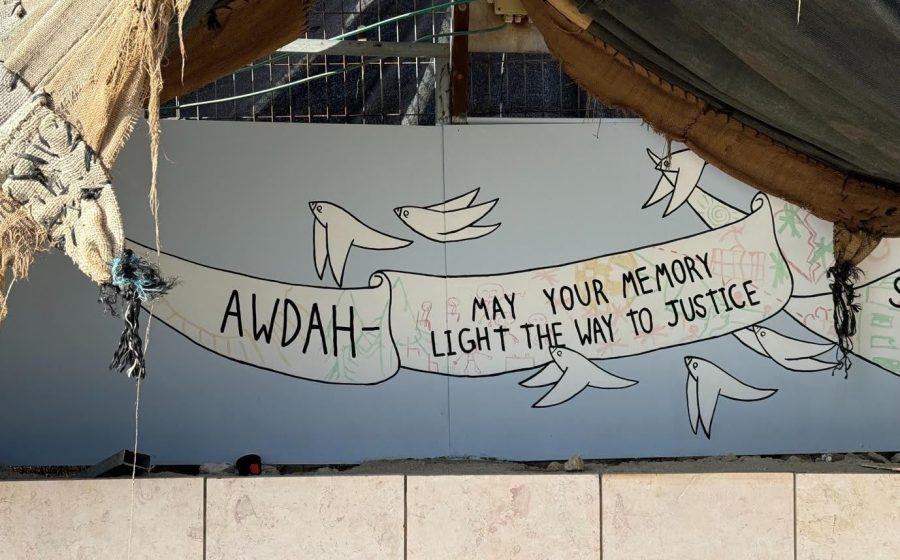
“Do you think there will be justice?” Eid asks. As he falls silent, the muezzin begins the call to prayer. It is around five in the evening. Another day of Ramadan is drawing to a close. An Israeli police vehicle cuts through Umm al-Kheir on the road leading to the settlement of Carmel. Behind it, dominating the space, a large sign in Awdah’s memory comes into view. It reads:
Awdah, may your memory light the way to justice.
Standing here. Staying here. Permanently here. Eternally here.
And we have one goal. One. One only: to be.