If unions are serious about reversing their decline, then shorter, smaller, faster first contracts might be what is needed to scale.
After three years of bargaining, the workers at the only unionized Chipotle store in the nation have called it quits on their fight for a first contract. The failure to win a first contract is not a reflection of the courage and tenacity of the workers, which they had in abundance, but a reflection of their inability to amass enough power to force Chipotle to cave. It was a valiant effort by the workers, but the outcome was sadly predictable under current conditions.
First contracts are a second chance for employers to break the union, and their most common strategy is a war of attrition: drag out bargaining, refuse to seriously entertain proposals, and send a steady message that collective bargaining — and by extension the entire unionization project — is futile. Labor law enforcement is so weak that companies violate the duty to bargain in good faith with impunity. Without strategic leverage and deeper organizing density, employers can and will simply refuse to bargain or just stall out negotiations indefinitely.
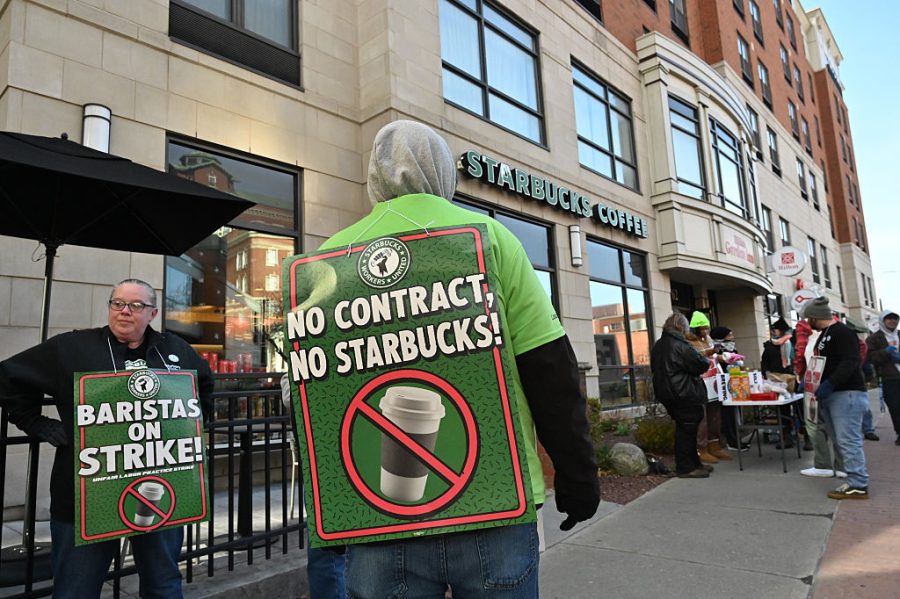
That story extends far beyond Chipotle. Philadelphia workers successfully unionized the first Whole Foods store in the country last January, but the Amazon-owned company has refused to recognize the union — much less initiate bargaining — for over a year. Starbucks Workers United has successfully organized hundreds of stores representing thousands of workers over the last five years but is still negotiating a first contract. At Volkswagen in Tennessee, United Auto Workers (UAW) members overcame the employer’s “last, best, final offer” and won a strong first agreement, but only after building a credible strike threat at the company’s sole US production facility.
There are no reliable statistics on how many successful union drives ultimately fail to secure a first contract, but available data shows that even unions that do win an agreement take, on average, at least five hundred days to get there. At Volkswagen, it took 502 days of negotiating to land the deal. At Starbucks, it is taking much longer.
Workers not only have to sustain a high level of organizing for an obscenely long period of time to pressure the employer into agreeing to terms; they also have to fend off renewed attacks. One major danger is that the average first contract negotiation lasts longer than the one-year “certification bar,” the National Labor Relations Board (NLRB) rule that prohibits decertification elections for up to twelve months after a union wins a board-certified election. While it is technically illegal for an employer to actively support a decertification drive, crafty managers often encourage their supporters from the shadows.
If 30 percent of workers in the bargaining unit, demoralized over the molasses-like pace of negotiations and worn down by the boss’s continued attacks, sign a decertification petition after the one-year mark and there are no blocking unfair labor practice charges, then negotiations immediately screech to a halt, and the union must once again fight for its very existence in a life-or-death NLRB election. Only after beating back the decertification election are negotiations likely to resume.
We should take seriously the possibility that labor is approaching what I’ve referred to elsewhere as an event horizon: a hypothetical point where union density becomes so small that unions are no longer capable of reversing their own decline. If that is the direction labor is headed, then it’s easy to see how first contracts are one of the largest challenges accelerating our descent into oblivion. This leads to what should be one of the most urgent questions confronting labor: Should we radically change how we approach first contracts?
Going Old School
To organize and grow union density at scale and rebuild the kind of power capable of once again setting a new standard of living for the working class — we may need to go old school. The UAW famously won its first contract at General Motors, then the largest and most powerful corporation in the world, after a forty-four-day sit-down strike at targeted choke points that shut production down entirely. The resulting agreement was exactly one page long. It granted union recognition. And that was it.
Less well known is the experience of the United Electrical, Radio and Manufacturing Workers of America (UE), a founding Congress of Industrial Organizations (CIO) union, in its fight for a first contract with General Electric (GE), then the largest electrical manufacturer in the country. Even after organizing thirty thousand GE workers into seven locals — still less than half GE’s workforce at the time — it took repeated attempts over several years for the union to secure an initial agreement.
GE, like virtually every employer since the dawn of capitalism, claimed a union was unnecessary because the company already treated workers generously and provided each of them with a handbook outlining the company’s labor policies, including wages, benefits, hours, overtime, layoffs, and vacations. After stalling out at the table for years, UE negotiators had the genius idea to seize on the company’s own claims. If these policies were so exemplary and the company intended to honor them, why not make them enforceable in a union contract?
The union proposed enshrining the handbook, word for word, into a one-year master contract covering all organized GE plants, with two small but important additions: an enforceable grievance procedure that would be implemented at each workplace through UE shop stewards and automatic inclusion of any future GE plant the UE organized into the deal.
Over the preceding two years, GE had faced off against an angry and organized workforce with no contract and no formal channels to settle their issues with management. Dozens of work stoppages had ensued, costing the company valuable production time. In the end, GE saw the wisdom in the union’s offer and agreed to the deal in the hope that it would help quell the stream of rebellions erupting in their plants. The resulting first agreement ran just six double-spaced pages (the company handbook was incorporated by reference in the contract and appended to the document).
What the UE leadership and negotiators realized was that it was more important to codify and legitimize their union, then continuing growing it, than it was to make progress on wages, benefits, and working conditions in the first agreement. That six-page first contract, small as it was, had a mighty impact, laying the foundation for deepening the union’s presence and leadership on the factory floor through the steward system and widening the union’s power by incentivizing workers in nonunion GE plants to join the UE so they could also be covered by the deal.
Both the UE and the UAW possessed immense structural leverage over the corporations. Through their collective action, workers created significant pressure that was choking the profits at two of the largest and most powerful corporations in the world — and both unions still won bare-bones first contracts. But those contracts laid the groundwork for the unions to grow, build more power, then win more.
There is no sugarcoating our current reality: breakthrough campaigns at employers like Chipotle are ending in defeat and even the campaigns that do reach a deal, like at Volkswagen, take five hundred days or more to get there. An all-or-nothing strategy of fighting for first contracts that run hundreds of pages and cover dozens of articles would be impossible to pursue in a moment where workers are organizing en masse — the exact conditions labor must manufacture if we hope to reverse our descent into oblivion.
One possible solution to the current quagmire of first contracts is to follow the historical examples of UE and UAW and shoot for more limited agreements — contracts that are small enough to win but big enough to matter and quick enough to scale.
I’m not arguing that this approach will be right in every case, or that newly unionized workers should universally temper their ambitions. I’m also not trying to provide cover for lazy staff or sellout leaders. But if labor is serious about reversing long-term decline, it is at least worth considering whether, in some organizing drives, a more limited first contract could better serve the larger project of building density and organizing at scale.
Shifting Strategies Requires Deepening Democracy
To even start experimenting with this new-yet-old-school model will require deepening union democracy through deeper internal conversations about bargaining strategy — conversations that are far too often confined to top union leaders and senior staff. That conversation ideally starts with workers while they are organizing and before they win their union, so expectations are collectively set early.
Winning a union election is like poetry in motion. The feeling of being at the union vote count and then hearing the board agents announce the results is electrifying. Then momentum collides with the grind of bargaining a first agreement. Much of the process is needlessly legalistic and often boring. In the end, workers will only win what they have the power to take. Without structural leverage — the ability to significantly disrupt the employer’s profits — workers aren’t going to win much, if anything.
Even when leverage exists, it must be built and sustained for far longer than most workers anticipate. Too often, contract demands harden into a wish list that doesn’t match the leverage workers have, and committee members become dug in after fighting for many months and even years for their proposals without getting anywhere. If a UE-style approach is going to be tried, workers must own it. They have to know going in that their goal is to establish their union and create a base camp from which further organizing is made possible, so they can grow their power and win more in the next round of negotiations.
This strategy will also potentially require a major shift in the mindset of union leadership. The most visionary labor leaders win the membership over to the understanding that density is destiny — that defending past gains and winning more at the bargaining table is dependent on growing the union’s size and capacity to strike at corporate America’s bottom line. As the old saying goes, the bigger the picket line, the shorter the strike. That principle holds true across entire industries.
But union leaders are elected by currently existing, dues-paying members. And there are legitimate concerns that if a first contract at a newly unionized company shop does not mirror the legacy agreements in the same industry, then employers will weaponize the new agreement as a pattern for a new, lower standard and demand concessions. This creates pressure on union leaders to insist that new contracts come as close as possible to the long-established deals, resulting in hundreds of proposals that play perfectly to the employer’s war of attrition strategy.
Same as the newly organized workers, if union leaders hope to build a scalable model for first contracts based on the UE approach, they must build consensus on this strategy across their union, getting support from the leaders and members in established shops, who should be expected to do everything they can to contribute to the success of the newly organized workplaces.
A New Minimal Program
The question is not what workers deserve (because every agreement falls short of that goal), but how to structure first agreements so they expand the power needed to win more over time. So what might a new minimal bargaining-to-organize-at-scale program look like?
The answer is going to require experimentation. Unions should craft their strategies to the context they are in: how work is structured and how much leverage the workers have, what the central concerns animating the organizing drive are, how the contract might inspire and incentivize further organizing at the same employer or across the industry. Nevertheless, here are three suggestions for a possible framework for an old-school-style contract.
First, if contracts are going to be slimmer, then they need to be shorter. This will allow workers to build on their previous gains relatively quickly and essentially guarantee that newly organized shops can coordinate and align their contract fights with already established units — so if one Chipotle or Whole Foods is capable of winning a first agreement, they can potentially be joined in the next round by more stores that followed their example.
That is easy to write but hard to accomplish. Just as getting employers to bargain in the first place, despite the law, is a question of power, so is forcing employers to bargain jointly with workers from across multiple sites. It takes even greater power to get them to agree to a master agreement under which all workers are covered. The only way that will happen is if workers can organize at scale and have the ability to collectively strike the employer, which one-year contracts might help to facilitate.
One-year deals will not necessarily be easy to win, though, especially since so few unions today have them. In 1947, surveys showed that about 75 percent of union contracts had a one-year term. By 1995, the last year those same surveys were performed, less than 1 percent of union contracts had a one-year term, while 64 percent were three years, and 30 percent were four years or more. It’s very likely that the trend of ever-lengthening contract durations has continued up to today. Employers favor longer agreements because they provide them certainty about labor relations and costs. But the trade-off for a skinnier, and therefore cheaper for the employer, agreement must be a shorter one.
The second is contract articles that embed the union in the workplace and provide basic rights and protections to members. Examples include clear language recognizing the union and the work that members perform, protecting currently existing work from outsourcing, just-cause protections and progressive discipline, a clear grievance procedure ending in arbitration, and providing union staff and leaders access to the workplace. It is hard to understate how transformational it is to win just-cause protections that end the employer’s at-will employment regime, in which workers can be fired at any time for any reason. Just cause is such an important worker right and powerful challenge to managerial authority that it could easily be the centerpiece of any first union contract, including an old-school minimalist deal.
Third is a more defensive battle: cutting down overly broad management rights clauses. Management rights clauses are essentially waivers by the union to bargain over changes made by the employer on particular subjects during the life of the agreement. The most insidious form of this is the “zipper clause,” which provides management the right to unilaterally make changes on any matter not explicitly covered by the contract. A zipper clause should be avoided if at all possible. Still, the impact of management rights clauses can be weakened by following the UE example and locking in as much of the employer handbook into the contract — thus making it subject to the grievance procedure and protecting it from unilateral change by management.
The management rights clause often goes hand-in-hand with a “no strike” clause: management agrees this is the deal, and it won’t change; in exchange, the union agrees to labor peace. There are a lot of romantic ideas in the labor movement about abandoning the “no strike” clause that defy the reality of the balance of power between workers and employers. The biggest problem that many newly organized shops face — like in the example of the solely organized Chipotle or Whole Foods in Philadelphia — is not that workers don’t have the right to strike, because they do, but that their strikes are too weak and won’t impact the employer’s bottom line with enough force to win substantive demands. And in any case, if the union is capable of winning a one-year duration, which will likely be difficult enough, then barring strike activity for only twelve months seems much more palatable.
This framework — shorter duration, focusing on embedding the union in the workplace, and narrowing the scope of management’s unliteral authority to make changes — is a starting point for deeper strategic conversations, not a universal prescription. My goal is not to lower expectations but to encourage workers and their unions to develop a serious, sober assessment of how much leverage they actually have at a particular employer and on that basis develop a creative, collectively owned plan to use their first contract to grow their union and build even more power in the years ahead. In a moment when union density is at its lowest point in a hundred years and when even successful first contract fights take five hundred days or more, we should at least consider whether slimmer, shorter, and strategically constructed agreements might create an opportunity to organize faster and begin concentrating power at scale.
The stubborn refusal by so many labor leaders to face reality, assess what isn’t working, and then debate these kinds of questions and experiment with new approaches will only further contribute to labor’s decline.