Kleber Mendonça Filho’s Oscar-nominated The Secret Agent examines how authoritarianism corrupts and distorts memory. Forty years since the end of Brazil’s military dictatorship, the rise of Jair Bolsonaro’s far right is proof.
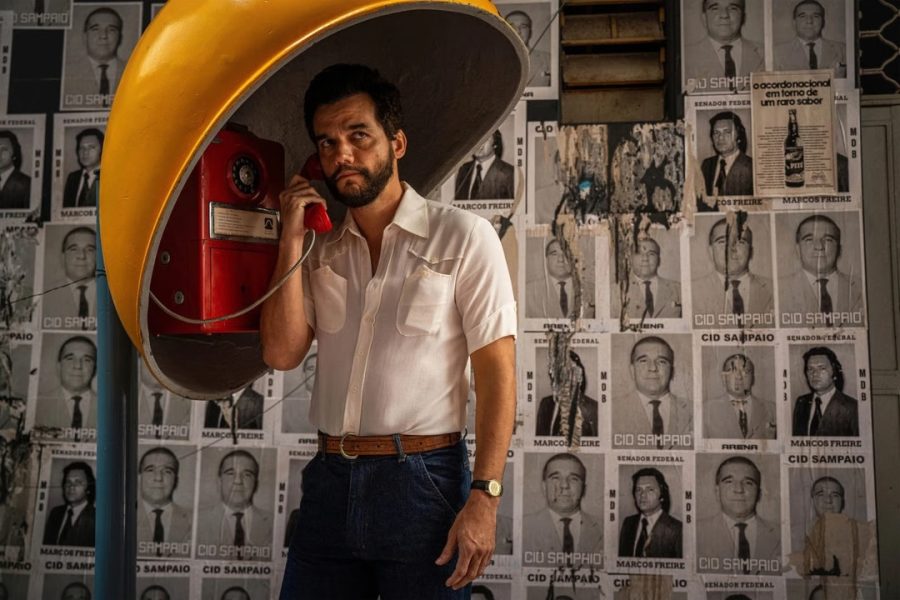
Forty years since the end of Brazil’s military dictatorship, seven since the election of a president who praised its torturers, and three since said ex-president attempted a coup of his own, it can be tempting to diagnose the whole country with a sort of national amnesia. This is, after all, the most optimistic explanation for the rise of Jair Bolsonaro and the far right. The least optimistic — that his supporters recognize his authoritarianism, in full knowledge of what that means — is more frightening. And the true explanation no doubt lies somewhere in between — somewhere in the mess of inherited memories and manufactured consent, of official archives and the archives stored in our flesh.
It is this mosaic of collective memory that animates The Secret Agent, director Kleber Mendonça Filho’s latest feature. Set in Recife in the midst of Brazil’s dictatorship — the title card reads simply “Our story is set in the Brazil of 1977, a period of great mischief” — the thriller follows Marcelo Alves (Wagner Moura), a widowed scientist on the run. At the start of the film, he’s driven three days straight to reach a safe house run by the elderly Dona Sebastiana (Tânia Maria); he’s left his young son (Enzo Nunes) in the care of his in-laws (Carlos Francisco and Aline Marta Maia); he is exhausted and has nightmares. Marcelo is not his real name. But though the title suggests otherwise, he is an ordinary guy who stood up to a powerful man — not a secret agent at all.
That anyone even hears Marcelo’s story, in fact, is thanks to a dissident fixer named Elza (Maria Fernanda Cândido) who might actually fit the “secret agent” bill. She is the one who warns Marcelo is under a death threat; who arranges for him to work, until his false passport is ready, at an ID card office in Recife; and who, in the face of planted news stories and rampant censorship, begins to conduct interviews of her own. It is Elza who challenges the official archives and records of the time — archives that comprise the film’s central motif and object of inquiry. For Mendonça, official records, those physical manifestations of public memory, are as crucial to the historical setting as they are to the plot and powerful enough, in their erasures and fabrications, to shape the story as it unfolds.
The Official Story
The first newspaper Marcelo encounters is the February 25, 1977, edition of the Diario de Pernambuco — a real Recife-based publication. He brings it to his first day of work, where a tour of the office leads him through a basement of stacked cabinets with yellowed files that he quickly learns are fundamentally flawed. When his boss asks for a name to demonstrate how to locate IDs, Marcelo offers his late mother’s, only to learn that men’s documents are easier to find. The tour then continues upstairs, past a wooden cross, a Brazilian flag, and a framed portrait of President Ernesto Geisel.
It’s when Marcelo finally reaches his desk and opens the newspaper that he meets police chief Euclides Oliveira Cavalcanti (Robério Diógenes), who approaches by nodding at the front-page story, “Carnival Death Toll: 91,” and predicting wryly that “It’s gonna be over 100.” (One dead body will, in fact, be covered by this very edition of the paper. But I’m getting ahead of myself.) In the moment, Marcelo feels only an instinctual aversion to Euclides — probably to most policemen of the era. What he does not yet know, that the audience does, is just how intertwined the police chief, the media, and state violence are.
In a plotline parallel to Marcelo’s, Euclides reads aloud another morbid headline: “Human Leg Found in Shark’s Stomach.” The police chief himself, the article confirms, is leading the investigation and is quoted as saying the case is “damn strange.” But when he flips the page to the next headline, “Agronomy Student Still Missing,” it is revealed not only that the found leg belongs to the student but that the police chief himself is the one responsible for his murder, or at least its cover-up.
“Nothing here,” Euclides says, reassuredly, of the articles. “Nor will there be.” When the chief’s son, also a cop, asks why he even bothers worrying about what’s printed in the paper — it is subject to the dictatorship’s censors, after all — he responds, “Because there could be little communist fuckers trying to trip us up.”
In a film that opts never to name the dictatorship, it is in dialogic moments like these that the director is most explicit about politics. Marcelo admits that he is “more communist than capitalist”; Dona Sebastiana says she was “a communist and then an anarchist, or was it the other way around?”; the residents of her safe house are “refugees.” The people attacking them, it’s implied, are capitalists, fascists, dictators, killers, but in some cases the details are vague. It is strongly hinted, for instance, that Marcelo’s late wife, Fátima, was murdered. But it’s almost as if, in not being completely explicit, Mendonça is mirroring the elusive nature of communication under surveillance or attempting to bring in the audiences that would be turned off by the mention of dictatorship off the bat. The effect is a movie that needs to be watched more than once to be fully understood.
In one such instance, the film takes a seemingly supernatural turn as it recounts the newspapers’ version of the disappearance of the found leg from the city morgue — lifted by the chief’s henchmen — in which the limb’s disappearance is blamed on a folkloric creature. In reality, headlines from the 1970s did repeatedly accuse a mythical being, the “hairy leg,” of attacking people in Recife’s streets. The stories were so unbelievable that some say they were coded denunciations of police violence. But in the film, people — Marcelo included — read the story and laugh. Horror and death, as long as they are not attributed to the state, sell well.
Eventually, the paper falsely accuses Marcelo of corruption and involvement “in crimes under investigation.” The mood is somber, the audience left to connect the dots. Brazil’s government in 1977 was more than “mischievous”; it was a dictatorship. Its principal concern was anti-communism, the police were agents of state terror, and the press was a tool for manufacturing consent.
The Real Story
In 1973, four years before The Secret Agent is set, my grandfather was killed by agents of the dictatorship in Recife. He was twenty-four, a medical student, a leftist. And though he — Jarbas Pereira Marques — and five others, Soledad Barret Viedma, Pauline Reichstul, Eudaldo Gomes da Silva, Evaldo Luís Ferreira de Souza, and José Manoel da Silva, were abducted and tortured before being killed, the headline published that week in the Diário de Pernambuco — the same newspaper that propels the plot of The Secret Agent — was “Security finishes off terror in Greater Recife.” The real headline in the Jornal do Brasil, a national paper still published in Rio de Janeiro, was “Six terrorists die in shootout in Pernambuco.” In the “official version, the version of the powerful, subversives always died in shootouts,” my mom writes in her memoir, Born Subversive. In the official version, dissidents are always terrorists.
As soon as I was old enough to google my own grandfather’s name, I found the articles. And though Brazil’s National Truth Commission had by then determined that the version reported by the press was false — thanks to people like my great-grandmother, who found her son’s body and demanded an autopsy despite threats to her family — the violence of the original archive remains. There are people today, like Bolsonaro himself, who still believe people like my grandfather were terrorists. There are people who read those newspaper stories in 1973 and never read a correction. There are people who have told me that they preferred Brazil’s dictatorship to today’s democracy, who deny or consent to or praise its violence. The same is true in Chile and Argentina. Whether you call it amnesia or denialism or something else, we have an existential issue with memory. We simply don’t remember the same way.
About halfway through The Secret Agent, Elza’s interview with Marcelo cuts to a contemporary office building where a young archivist named Flávia (Laura Lufési) listens in on their conversation on the cassette. She and her colleague, it turns out, are university researchers tasked with transcribing Elza’s archive. When they’re first introduced, they seem like a heavy-handed device to connect past and present, not characters in their own right — but then, in a nod to the dictatorship denialism of Bolsonaro, the university orders them to halt their work and return the tapes. They contain, leadership explains, “sensitive information.” But Flávia, now too invested to quit, goes rogue. She decides to search for Fernando, Marcelo’s adult son.
When Flávia eventually meets Fernando (also played by Wagner Moura), she brings a gift: Elza’s now doubly clandestine archive, copied onto a flash drive. She pushes the USB across the table; Fernando stares for a while before reluctantly pocketing it. He doesn’t remember his father, he admits. In fact, Flávia must know more of his story than he does. He has no records of him, and it is painful to try and remember.
But despite what Fernando says, Flávia finds, in him, an archive too. He has his father’s face and the voice she’s gotten to know from Elza’s tapes. He is the evidence his parents lived, the evidence his paternal grandmother existed, despite the document his dad never found. He is his father’s son — the same way my mom is her father’s daughter. She has his ears, and his eyes, and the name he chose for her. She’s heard stories about how he liked dancing, and onions, and Leo Tolstoy’s Anna Karenina; how he lent books to friends from the bookstore where he worked, as long as they promised to return them in pristine condition; how he lost a twin brother as a child and was born in the last week of August, like me; how he believed his country could do better by its people; how he was a person, a universe. I’ve heard those stories too.
The Secret Agent, then, is a reminder that even in authoritarian contexts, even under the most hostile of circumstances, we have not stopped creating archives of our own — clandestine cassette tapes, photographs, stories passed down across generations, memoirs like my mother’s about childhoods in exile, children and grandchildren who inherit our names and struggles and hope. That we even have a fighting chance at a shared, accurate understanding of our past is thanks to this recordkeeping, documentation, and investigation of truth.
Forty years since the end of Brazil’s military dictatorship, Kleber Mendonça Filho asks which voices we’ll turn to and which records we’ll share. How will we remember? How will we live?