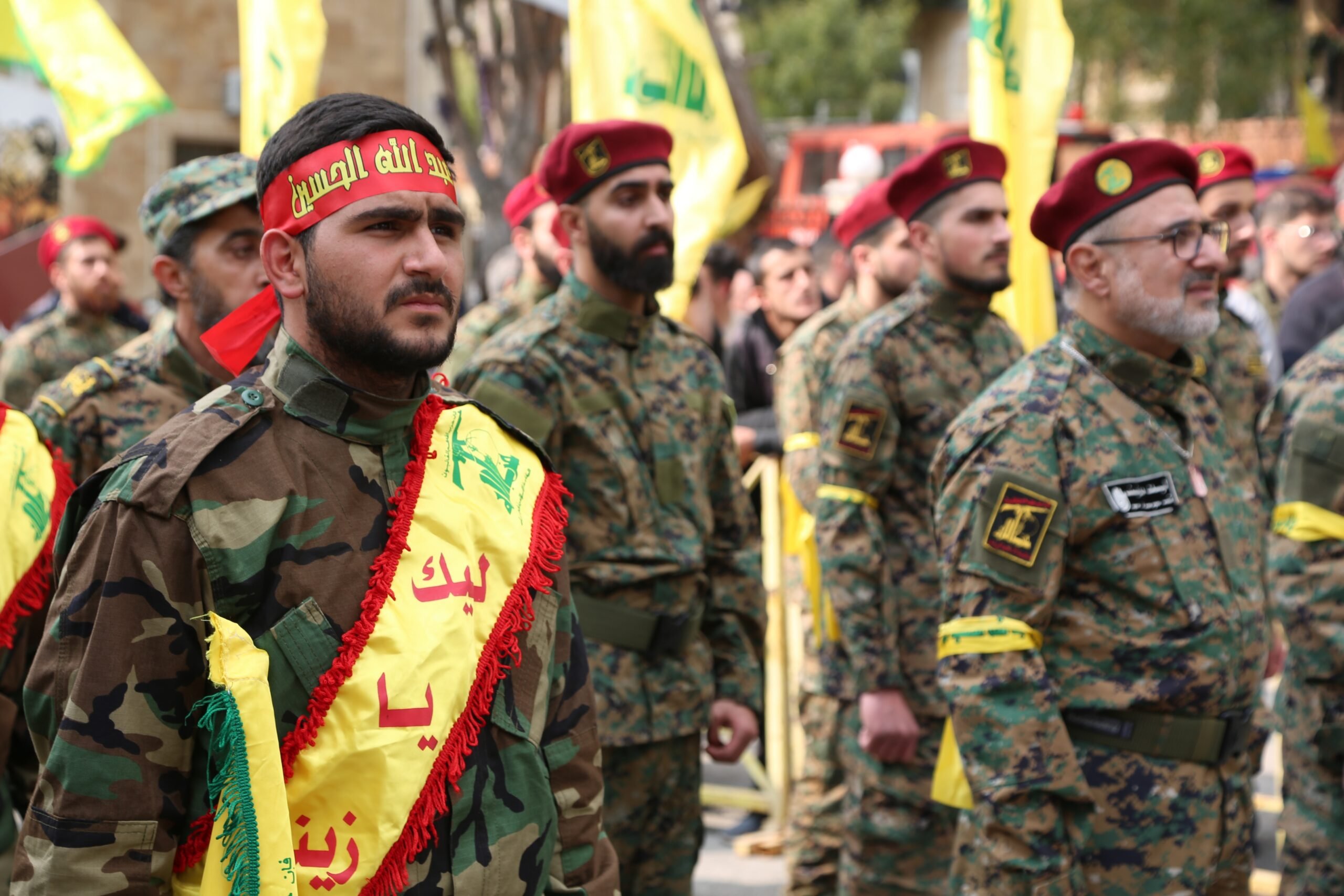
The Israel Defense Forces said on Monday that it killed two Hezbollah operatives in separate precision strikes in southern Lebanon.
By Ailin Vilches Arguello, The Algemeiner
Lebanese army members and residents inspect damage in the southern village of Kfar Kila, Lebanon, Feb. 18, 2025. Photo: REUTERS/Karamallah Daher
With Hezbollah reportedly rebuilding its military arsenal, the United States and Israel are intensifying pressure on the Lebanese government to disarm the terrorist group and establish a state monopoly on weapons, as tensions rise along Lebanon’s southern border and the risk of renewed conflict grows.
The Israel Defense Forces (IDF) said on Monday that it killed two Hezbollah operatives in separate precision strikes in southern Lebanon. The announcement came one day after the Israeli military said in a statement that it had eliminated four members of Hezbollah’s elite Radwan Force.
Last week, Israel launched airstrikes targeting Hezbollah terrorists and operatives responsible for the Islamist group’s logistical network in Lebanon, claiming they were working to rebuild Iran-backed Hezbollah’s terrorist infrastructure in the region.
Israeli Prime Minister Benjamin Netanyahu warned on Sunday that Hezbollah was seeking to rearm and that Israel would exercise its right to self-defense under last year’s ceasefire accord if Lebanon, which borders the Jewish state to the north, failed to disarm the Lebanese terrorist group.
“Hezbollah is constantly taking hits, but it’s also trying to rearm and recuperate,” Netanyahu said at the start of a weekly cabinet meeting,
“We expect the Lebanese government to uphold its commitments, namely, to disarm Hezbollah. But it’s clear that we’ll exercise our right to self-defense as stipulated in the ceasefire terms,” he said. “We won’t let Lebanon become a renewed front against us, and we’ll do what’s necessary.”
Israeli Defense Minister Israeli Katz expressed similar sentiments, specifically calling out Lebanon’s president.
“Hezbollah is playing with fire, and the president of Lebanon is dragging his feet,” Katz said in a statement. “The Lebanese government’s commitment to disarm Hezbollah and remove it from southern Lebanon must be implemented. Maximum enforcement will continue and even intensify – we will not allow any threat to the residents of the north.”
Lebanese President Joseph Aoun last week ordered the army to confront IDF incursions along the southern border, after accusing Israel of hindering prospects for negotiations by escalating its military operations inside the country.
“Lebanon is ready for negotiations to end the Israeli occupation, but any negotiation … requires mutual willingness, which is not the case,” Aoun said Friday during a joint press conference with German Foreign Minister Johann Wadephul in Beirut.
Israel “is responding to this option by carrying out more attacks against Lebanon … and intensifying tensions,” the Lebanese leader continued.
According to Hanin Ghaddar, a senior fellow at the Washington Institute for Near East Policy, US and Israeli officials have sent a clear message: if Lebanon fails to properly implement the ceasefire agreement and take stronger action to disarm the Iran-backed terrorist group by the end of the year, Israel will continue to step up its operations along the southern border.
“Lebanon prefers to avoid confronting Hezbollah — essentially, it would rather let Israel do the job than have the Lebanese army face the group directly,” Ghaddar told The Algemeiner.
She explained that the Lebanese government has reportedly considered a plan to disarm Hezbollah south of the Litani River, located roughly 15 miles from the Israeli border, and contain it to northern areas, but noted that such an approach is unlikely to succeed, as Israel will not tolerate the terrorist group’s presence anywhere in the country.
An Israeli official told the Saudi-owned Al Arabiya TV channel on Sunday that there are “serious estimations” Hezbollah is rebuilding its military capabilities and has smuggled hundreds of short-range missiles from Syria.
“Israel has relayed a message to the Lebanese side that it might again bomb Beirut’s southern suburbs if Hezbollah is not disarmed,” the official told Al Arabiya. “We will not allow the rebuilding of the Lebanese villages that lie directly on the northern border.”
The Israeli added that the IDF will continue occupying five Lebanese hilltop locations and has no plans to withdraw in the “foreseeable future.”
Amid rising tensions and increasing chances of renewed conflict with Jerusalem, new reports indicate that Hezbollah has been actively rebuilding its military capabilities, in violation of last year’s ceasefire agreement with the Jewish state.
On Friday, The Wall Street Journal reported that Hezbollah is restocking rockets, anti-tank missiles, and artillery, effectively rebuilding its armaments and battered ranks.
With support from Iran, Hezbollah is intensifying efforts to bolster its military power, including the production and repair of weapons, smuggling of arms and cash through seaports and Syrian routes, recruitment and training, and the use of civilian infrastructure as a base and cover for its operations.
“The Iranians are much more involved in Lebanon today since Nasrallah was killed, because there is no clear leadership,” Ghaddar told The Algemeiner, referring to Hezbollah’s longtime leader Hassan Nasrallah, who was killed during last year’s war with Israel.
“It’s more of an Iranian occupation now, not just a proxy influence,” she continued. “The stronger Hezbollah becomes, the weaker Lebanon gets, and the prospects for disarmament and peace will continue to diminish.”
At a conference in Bahrain on Saturday, US Special Envoy Thomas Barrack warned that Hezbollah maintains an estimated 40,000 fighters in the country, along with 15,000 to 20,000 rockets and missiles. He also described Lebanon as a “failed state” and said it probably won’t be able to comply with the US demand that it disarms Hezbollah.
In recent weeks, Israel has conducted strikes targeting Hezbollah’s rearmament efforts, particularly south of the Litani River, where the group’s operatives have historically been most active against the Jewish state.
For years, Israel has demanded that Hezbollah be barred from carrying out activities south of the Litani.
According to Ghaddar, Jerusalem is considering further escalation in Lebanon, but what form that might take remains unclear.
She explained that a new conflict could involve continued strikes against Hezbollah’s arsenal and personnel, or expand to residential areas where the group is hiding strategic weapons.
“Israel has more opportunity to act now because Hezbollah is at its weakest. The terror group is trying to rearm but hasn’t succeeded yet,” Ghaddar told The Algemeiner. “If Israel waits, Hezbollah will only grow stronger.”
Even though the US is giving the Lebanese army until the end of the year to finish operations south of the Litani River and begin moving north, Ghaddar warned that if the government does not start the second phase immediately, Washington could give Israel the green light to take military action.
For the Lebanese government, the challenge is not just stepping up efforts to meet the ceasefire deadline to disarm Hezbollah but also preventing the country from plunging into a civil war.
Hezbollah has repeatedly defied international calls to disarm, even threatening protests and civil unrest if the government tries to enforce control over its weapons.
Last week, Hezbollah chief Naim Qassem once again refused to lay down the group’s arms, insisting that its military arsenal is a “legitimate tool for resisting Israel’s occupation and threats.”
Earlier this year, Lebanese officials agreed to a US-backed disarmament plan, which called for the terrorist group to be fully disarmed within four months — by November — in exchange for Israel halting airstrikes and withdrawing troops from the five occupied positions in the country’s southern region.
According to Ghaddar, the main problem is that the Lebanese forces’ plan to disarm Hezbollah lacks a clear timeline.
So far, they have only set a deadline to complete operations south of the Litani River by the end of the year, with the next phase moving north of the river and eventually covering the rest of the country.
“It is definitely unrealistic for the Lebanese army to achieve full disarmament by the end of the year,” Ghaddar said, noting that the subsequent phases, for which they refuse to provide a timeline, could take months or even years.
“The goal should be to reach a better agreement now. The ceasefire was a good start, but it lacked a clear timeline, and Hezbollah is using this period to rearm and rebuild itself militarily, financially, and politically,” she continued.
Ghaddar also said any new agreement should require Lebanon to engage in direct peace negotiations in order to politically weaken Hezbollah and secure an end to the conflict through a negotiated settlement.
In these efforts, she argued that the US could play a central role by pressuring the Lebanese government through sanctions, intensified diplomatic efforts, and conditional support for the Lebanese army to ensure meaningful progress.
The post US, Israel pressure Lebanon as Hezbollah rebuilds military arsenal, risk of renewed conflict looms appeared first on World Israel News.