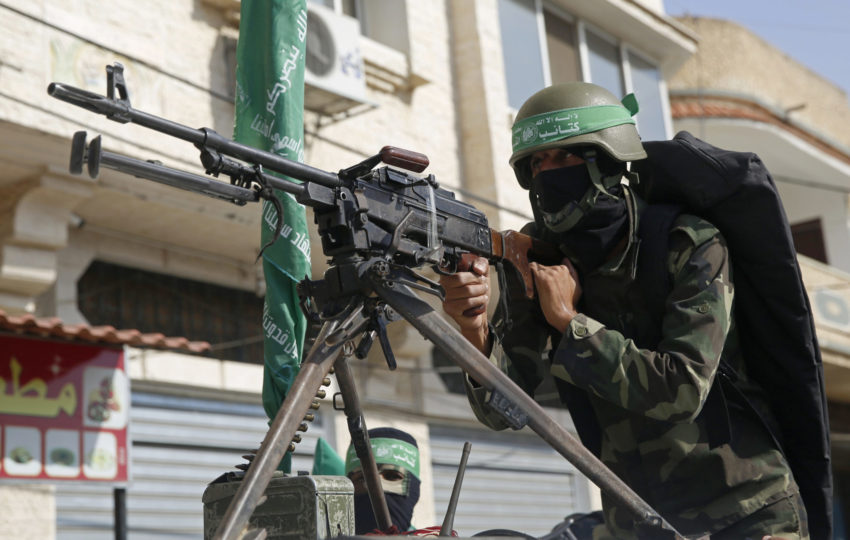
Diplomatic agreements signed by governments mean little to organizations that define themselves through permanent armed struggle.
By Khaled Abu Toameh, Gatestone Institute
For decades, Western diplomats and decision-makers have clung to one of the most dangerous illusions in the Middle East: the belief that Islamist terrorist organizations can be persuaded through negotiations and diplomatic agreements to surrender their weapons and abandon their jihad (holy war) against Israel.
Reality continues to prove that persuading terrorist regimes to give up their weapons is not the walk in the park they might have hoped.
More than seven months after US President Donald Trump unveiled his peace plan for the Gaza Strip, the Iran-backed terrorist group Hamas remains armed, entrenched, and firmly in control of large parts of the territory.
Despite months of negotiations conducted by Trump’s “Board of Peace,” Hamas has refused to lay down its weapons or relinquish power.
Instead, it continues to attach impossible conditions to any discussion of disarmament, foremost among them a complete Israeli withdrawal from the Gaza Strip.
Similarly, in Iran’s negotiations with the US, the ruling Islamic Revolutionary Guard Corps regime demands a complete Israeli withdrawal from southern Lebanon.
Under the current circumstances, such moves on the part of Israel would pave the way for endless deadly massacres of Israelis.
Now Washington has brokered another ambitious agreement—this time between Israel and Lebanon—that seeks to restore Lebanese sovereignty by eventually disarming Hezbollah and dismantling its military infrastructure.
The agreement contains several welcome provisions and offers a potentially historic opportunity to end decades of hostility between Israel and Lebanon.
Unfortunately, like the Gaza initiative before it, the Lebanon agreement risks becoming another document that looks impressive on paper but proves impossible to implement because it rests on a false assumption: that terrorist organizations honor agreements and voluntarily disarm.
Hamas has already demonstrated the failure of that assumption. Hezbollah appears determined to prove it once again.
The failure of Trump’s Gaza initiative should have served as an important lesson.
Instead, Washington continues to negotiate as if Hamas were a rational political movement rather than a jihadist organization whose declared objective is Israel’s destruction.
Seven months of diplomacy have produced no meaningful results. Hamas remains in power.
It continues to recruit fighters, rebuild its military infrastructure, and prepare for future attacks against Israel.
Its leaders openly reject demands to disarm while insisting that the group’s weapons are “non-negotiable.”
Hamas has even demonstrated that it retains sufficient control over the Gaza Strip to suppress internal opposition.
On June 26, Hamas succeeded in foiling an uprising that was being organized against its rule.
The organizers, Hamas opponents and critics living abroad, were hoping that tens of thousands of Palestinians would take to the streets that day to protest the terrorist group’s continued rule.
This uprising did not take place for a number of reasons, including tough Hamas security measures and ongoing support for the terrorist group.
If Hamas can still intimidate Gaza’s population nearly three years after the October 7 massacre and more than seven months after Trump’s peace initiative, it is difficult to argue that diplomatic pressure has significantly weakened the group.
The same reality now confronts Lebanon and Iran.
The framework agreement signed in Washington between Israel and Lebanon deserves recognition for several positive elements.
It formally commits both countries to pursue peaceful relations, seeks to restore the authority of the Lebanese state, provides for a process aimed at dismantling Hezbollah’s military infrastructure, and includes an important provision designed to prevent reconstruction funds from reaching Hezbollah and other non-state armed groups.
If implemented, these measures could help strengthen Lebanese sovereignty while reducing Iran’s influence inside Lebanon.
The problem is that Hezbollah, like Iran, has already made clear that it has no intention of allowing the agreement to succeed.
Within hours of its signing, Hezbollah Secretary-General Naim Qassem denounced the framework agreement as “humiliation and disgrace,” declared it “null and void,” and accused the Lebanese government of surrendering Lebanon’s sovereignty.
He rejected any linkage between Israel’s withdrawal from southern Lebanon and Hezbollah’s disarmament and described such demands as crossing “red lines.”
Instead, Qassem insisted that Lebanon adhere to the separate Memorandum of Understanding signed between the United States and Iran—a document that does not require Hezbollah to surrender its weapons.
Hezbollah’s political representatives and allies quickly joined the campaign against the agreement.
Lebanese Parliament Speaker Nabih Berri warned that the deal represented “incitement to civil war.”
Hezbollah parliamentarian Mohammed Raad accused the Lebanese government of “complete submission to America and the Zionist enemy.”
Even the Iran-backed Houthi militia in Yemen entered the debate.
While calling on the Lebanese people to overthrow their government, it warned that the agreement would either trigger civil war in Lebanon or lead to Israeli occupation.
These reactions expose the central weakness of the agreement.
Hezbollah does not recognize the authority of the Lebanese government to determine its military future.
Like Hamas in the Gaza Strip, Hezbollah believes that its weapons are sacred because they serve what it calls the “resistance”—or for Iran’s regime, their survival.
Diplomatic agreements signed by governments mean little to organizations that define themselves through permanent armed struggle.
The contradiction in current American policy further complicates matters. Within less than two weeks, the Trump administration helped produce two agreements that appear to move in opposite strategic directions.
The agreement with Lebanon seeks to weaken Hezbollah by restoring Lebanese sovereignty, dismantling the terrorist organization’s military infrastructure, and preventing reconstruction funds from reaching it.
The Memorandum of Understanding with Iran, however, provides extensive economic relief to the Iranian regime. It allows renewed Iranian oil exports, eases banking restrictions, and grants access to frozen Iranian assets.
These measures may stabilize relations between Washington and Tehran, but they also strengthen the principal sponsor of Hezbollah.
This inconsistency cannot be ignored. One agreement attempts to close Hezbollah’s financial pipeline. The other opens the financial pipeline of Hezbollah’s primary patron.
According to the US Treasury Department, Iran’s Islamic Revolutionary Guard Corps-Quds Force transferred more than $1 billion to Hezbollah since January 2025, through Lebanese financial networks and exchange houses.
American officials have also identified smuggling and financing routes involving Turkey, Iraq, Dubai, and other regional hubs.
Without cutting off Iranian funding, Hezbollah will simply rebuild. Money finances salaries, recruitment, weapons procurement, tunnel construction, propaganda, political patronage, and military infrastructure.
Destroying weapons depots accomplishes little if Tehran continues replenishing Hezbollah’s resources.
One cannot realistically expect Lebanon to dry up Hezbollah’s finances while simultaneously allowing Iran to refill them.
Nor should anyone expect the Lebanese government to accomplish what it has repeatedly failed to do for many years — defeat a terrorist group such as Hezbollah.
Successive Lebanese governments have promised to assert state authority throughout the country.
Yet Hezbollah has remained a state within a state, maintaining its own army, intelligence apparatus, communications network, financial system, and foreign policy.
Likewise, the Palestinian Authority (PA) has long claimed that it could eventually govern Gaza and replace Hamas. That claim has always lacked credibility.
The PA is too weak to confront Hamas militarily, just as the Lebanese government lacks both the political consensus and military strength to disarm Hezbollah.
This disparity does not mean that the Israel-Lebanon agreement should be dismissed.
On the contrary, it offers an opportunity to strengthen Lebanon’s sovereignty, improve Israeli-Lebanese relations, and reduce the risk of another devastating war.
The agreement will succeed only if it is enforced. This condition means sustained American pressure on the Lebanese government to fulfill its obligations, strict monitoring of Hezbollah’s activities, aggressive efforts to block Iranian financing, and clear consequences if Hezbollah continues to rebuild its military capabilities.
Words alone will not disarm Hezbollah. They have not disarmed Hamas or Iran. The failed experience of Gaza should serve as a warning rather than a model.
The lesson from all three—Gaza, Lebanon, and Iran—is that terrorist organizations do not surrender their weapons because diplomats ask them to.
They do not abandon their weapons because agreements are signed in Washington, Geneva, or elsewhere.
Terrorist organizations survive through ideology, intimidation, military force, and financial support.
Until those realities are addressed, diplomatic agreements will remain little more than signatures on paper while Iran and its proxies continue rebuilding, rearming, and preparing for the next war.
The post Paper agreements will not disarm terrorists appeared first on World Israel News.