Socialist candidates for Congress are on a roll this election cycle.
In May, Pennsylvania state house member Chris Rabb, endorsed by the Democratic Socialists of America (DSA), as well as incumbent democratic socialist representatives Alexandria Ocasio-Cortez and Rashida Tlaib, pulled a victory in the Democratic primary election for the state’s Third Congressional District. And just last week in New York, two socialist challengers backed by Mayor Zohran Mamdani and the New York City DSA chapter — Claire Valdez and Darializa Avila Chevalier — won upset victories in their own primaries. Given the heavily Democratic skew of their districts, all three candidates are expected to easily win their general election races this fall.
Tomorrow’s primary elections in Colorado are a chance for the Left to send yet another socialist to Capitol Hill. Melat Kiros is a twenty-nine-year-old first-time congressional candidate running in Colorado’s First District, challenging longtime incumbent Diana DeGette. Kiros, who was fired from a previous job as an attorney for standing up for the rights of pro-Palestine protesters, has the support of DSA, Bernie Sanders, and a number of labor unions and progressive organizations. In an interview with Jacobin, Kiros talked about her journey to running for office, the importance of electing representatives who reject corporate donations, and why she identifies as a democratic socialist.
-
Sara Wexler
Why are you running for Congress?
-
Melat Kiros
Because Denver has had the same stagnant leadership for the last thirty years, a representative who’s taken millions of dollars from Big Pharma, big energy and oil, defense contractors, and AIPAC [the American Israel Public Affairs Committee]. We deserve leadership that reflects our values in one of the most progressive, youngest districts in the country. And tomorrow we have a chance to make that happen.
-
Sara Wexler
What are the main issues you’re running on?
-
Melat Kiros
I have this fundamental belief that regardless of where you’re born, regardless of what family you’re born to or what body you’re born into, you deserve housing, health care, nutrition, [respect for your] faith, public education — all these basic needs. So I’m fighting for things like Medicare for All, Housing First, and universal childcare and eldercare.
The thing that I’m making the number one piece of this campaign is the fact that we already know that we need Medicare for All. We already know that we need Housing First, and that we need free public transit. The thing that’s standing in the way of that is the corruption in government and the money in our politics. So [we are] identifying that with the incumbent that I’m challenging — making it clear that I’m the only candidate in this race who’s refusing corporate PAC money, and will always refuse corporate PAC money, and is laser-focused on making meaningful steps toward getting publicly financed elections, because that’s the only way we get all of these programs.
We already have the popular support. Most of these policies have support from over 60 percent, sometimes 70 percent of the American public across party lines. The thing that’s holding us back is not popular will; it’s political will. That’s what this campaign is about.
-
Sara Wexler
That anticipated my next question. You’re running against Diana DeGette, the Democratic incumbent, who is running for a sixteenth term in Congress. What would you say most distinguishes your campaign from hers? She at least says she supports Medicare for All and seems to have some progressive or quasi-progressive positions.
-
Melat Kiros
I do not believe that you can meaningfully fight for Medicare for All when you’re taking money from big pharmaceutical companies and big health insurance companies that would effectively be legislated out of existence if we did get Medicare for All. I think it’s important that regardless of voting record, we pay a greater deal of attention to the donations that some of these legislators get, because corporations and special interests aren’t making these donations out of charity.
I have this fundamental belief that regardless of where you’re born, regardless of what family you’re born to or what body you’re born into, you deserve housing, health care, public education.
There is a return on their investment. Sometimes the return on the investment is somebody who doesn’t meaningfully progress the agenda for working families, somebody who can take the affirmative progressive vote to defend her record in one of the most progressive districts in the country without actually doing anything to get Medicare for All passed. The policy director at National Nurses United said as much: they’re grateful that [DeGette] is a cosponsor of the legislation but are wary of anybody who takes money from the same companies that don’t want to see Medicare for All passed. Why would they be giving you this money if they thought that you were fighting for this legislation?
It’s really important, as a movement that is working toward this agenda of bringing relief for working families, that we understand that we can’t just focus on the obvious villains, the ones who are very clearly not voting in line with their district or actively harming working families, but also the folks who are doing nothing but just keeping a seat warm and not actually helping [advance progressive priorities]. We don’t have time to not be fighting tooth and nail right now. Artificial intelligence is coming. Climate change is already here. ICE is terrorizing all of our neighbors. You have to be at the forefront of this fight, fighting aggressively for working families and to get corruption out of government. And if you are not, then I’d argue that is complacency with the system as it exists today.
-
Sara Wexler
Your parents came to America from Ethiopia just after you were born. I’m wondering how your immigrant upbringing might have shaped your politics and informed your campaign today.
-
Melat Kiros
My dad was selected for the Diversity Visa lottery program, which is exactly what it sounds like. It’s a lottery. So for as long as I can remember, I have always thought about how the only thing separating me from a young girl who grew up in the northern region of Ethiopia was luck. A lot of young people in the northern region of Ethiopia experienced the genocide just a few years ago, which particularly terrorized young women.
This idea that luck is the only thing that brought me to a country where there’s this much prosperity and this much opportunity, compared to the place where I emigrated from, was never lost on me. And I always understood that I didn’t do anything to deserve it. It wasn’t like I was worthy of these opportunities for some inexplicable reason — it’s just luck. So I’ve always wanted to find a way to serve, to be able to make those conditions and these systems not just [work] on the basis of luck.
Regardless of where you are, you should be able to get housing and health care and not worry about whether a bomb is going to drop on you and your entire family. These things are basic rights. That’s how I’ve always looked at my own place here and my own place in this country as an immigrant, compared to all the other people who don’t have the same opportunity.
On top of that, being an immigrant in this country and watching my parents tirelessly work to navigate a whole new country, to put my dad through pharmacy school, growing up and seeing how my community showed up for one another . . . I’d come home from elementary school on some days and there’d be groceries on our doorstep because one of our family friends just wanted to help us out for the week. Or on the weekends, the aunties would take turns watching all the kids because none of us could afford childcare.
Seeing people show up for one another and understanding that community is supposed to be where no one gets left behind — I believe that that should also be the role of government, where people don’t have community or family to step in and support one another. Those basic needs should be guaranteed for everybody regardless of their circumstances.
-
Sara Wexler
We’re about the same age, on the millennial–Gen Z cusp. Bernie Sanders’s presidential campaigns, Donald Trump’s first and second election, the 2020 Black Lives Matter protests, and the movement for Palestine all happened when you were in high school and college and shortly after. What was your relationship to these events? How did they impact your decision to enter electoral politics?
-
Melat Kiros
Growing up and seeing Bernie’s first presidential campaign, but also Trump — I grew up in circumstances that I think folks would look at and say, “Your dad achieved the American dream.” He went to America with nothing to his name, went to pharmacy school, got a job, bought a home, sent his kids to college. So I remember when Trump came down the pike, I was like, “What am I missing here? Where’s all of this energy coming from?”
What I always say to folks is that in law school, I realized the system isn’t broken; it’s actually working exactly as it was designed to. And our generation, I think, is starting to see the real fissures in the system. Meritocracy — if it ever really existed — whatever was left of it was disappearing.
I do not believe that you can meaningfully fight for Medicare for All when you’re taking money from big health insurance companies that would effectively be legislated out of existence if we did get Medicare for All.
The way we’ve designed not only our economy but also our government to prioritize the needs of property, to prioritize the needs of the wealthy — [I was shaped] by seeing that in Bernie’s message and his first campaign and seeing that during BLM and how those protests [resulted in] nothing tangible. And I saw that the system worked to neutralize a lot of that protest by corporatizing it.
So many of these corporations were like, “Yeah, Black Lives Matter.” I started learning a little bit more about some of those DEI programs that came about as a result of the BLM protests, and understanding affirmative action a little bit more, and seeing that a lot of the recipients of these programs were people who were already coming from fairly wealthy and comfortable backgrounds. They belonged to minority groups, but they were financially secure to begin with. So I remembered thinking there are so few people talking about the class consciousness that we’re missing, in a way that Bernie has been doing for decades now.
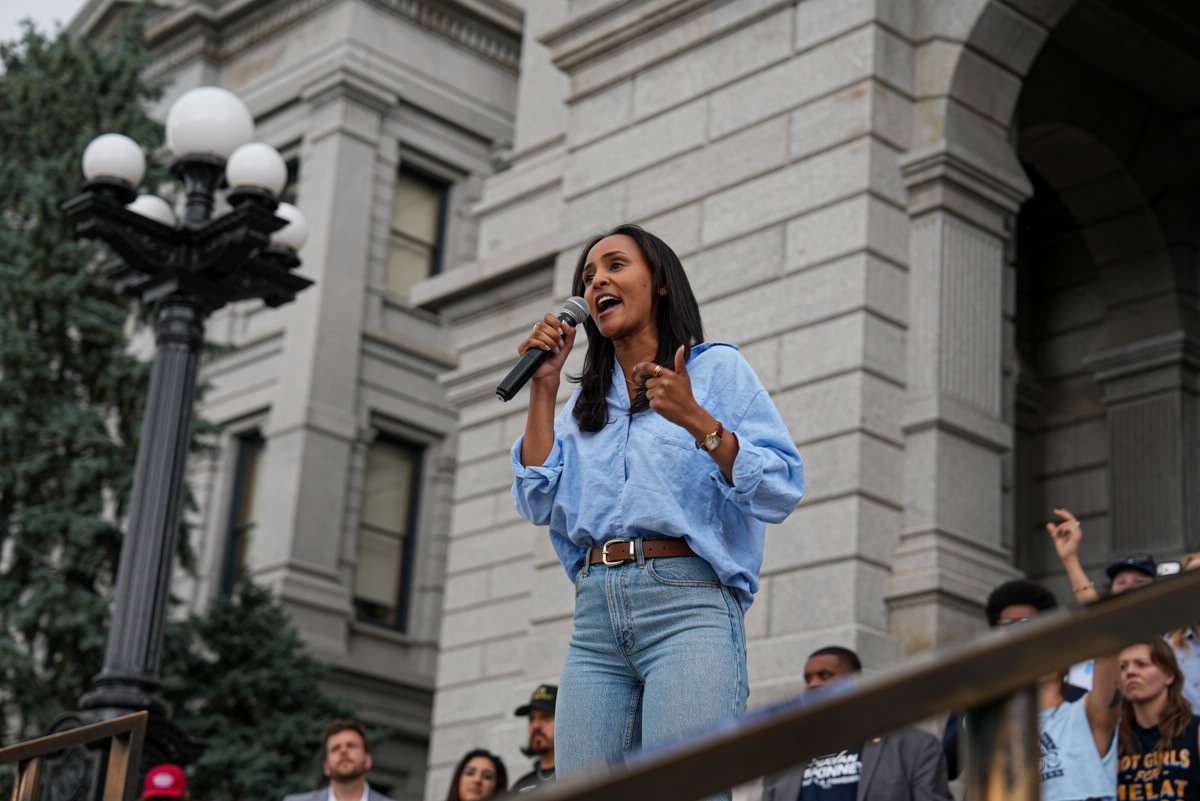
“The system is designed to prevent people from being able to hold government accountable and to hold power accountable.” (Kiros for Congress) All of these things back-to-back, including the pandemic — all of these different things came together for folks to realize how rigged everything has been from the beginning. That’s where I came from, at the end of law school, arguing with classmates about whether it was conscionable for a contract to charge a single mom 300 percent interest for a refrigerator and realizing this isn’t an education problem; this isn’t an information problem; this is an empathy problem and a class problem.
It has all worked step-by-step for me to realize that there is no way out of this crisis and the wealth inequality that we’re seeing without the kind of bold, transformational policies that Bernie was calling for. I think his first campaign was maybe too early for many folks to really understand the gravity of the situation. But because Bernie’s who he is, he never stopped, and now we’re seeing the fruits of that campaign with all the people who are running all across the country, pushing forward that message now too.
-
Sara Wexler
What were you doing prior to this campaign?
-
Melat Kiros
Most recently, I’ve been a PhD student at the University of Colorado Denver, studying the issue of money in politics; I’m on a leave of absence now. Before that, I was working as a communications director on a congressional campaign. That was a wild experience where I learned a lot about politics and the party and all these things.
Before that, I was an attorney, practicing for about a year. I was in New York City doing securities regulation. I mentioned law school was where I realized everything was rigged, and I think I fell into the trap that a lot of young people fall into, which is, What on Earth am I able to do as an individual? What’s the point? I’d always joke with my little sister, “We’re cooked: the planet’s burning, the government’s corrupt, wars are continuing recklessly all around the world.”
I was like, I’m just going to go to a big law firm so I can pay off all these loans, maybe help my parents retire, and then maybe I’ll go to a [government] agency afterward and hold some corporations accountable. But I was like, there’s nothing meaningful that I can do in service of people right now. I felt so despondent.
But when I was practicing, October 7 happened, and the following week students were protesting what was an immediately disproportionate response from Israel, which eventually became a genocide. I protested when a genocide was happening in Ethiopia, and no one was threatening my job; no one was trying to blackball me from law firms. But that’s what was happening to these student protesters. I remember thinking, these kids are risking their entire careers because they know that this moment is bigger than them. And I was like, “What’s my excuse?”
So I wrote an article defending them and their right to protest, particularly as attorneys and as people who are meant to be protecting our Constitution, but also defending the legitimacy of criticizing Israel — not just its actions but the structure of how Israel is organized as a state, as an ethnocracy that only guarantees self-determination for Jewish Israelis and the danger that comes with ethnocracies or theocracies or any government that protects only one class of people. My firm asked me to take it down that morning, and I said no.
There is no way out of the wealth inequality that we’re seeing without the kind of bold, transformational policies that Bernie was calling for.
The following day I was fired, and that was when I decided this isn’t where I want to be anymore. I got messages from so many people who were like, “I wish I could have spoken out too.” But someone found out she was pregnant, and she couldn’t afford to not have that childcare or the maternity leave. Somebody else found out that her husband just lost his job, so she was the only one providing health care for their family. All of these people were saying, “I wish I could speak out, but I can’t risk losing this job. I can’t risk losing the livelihood that comes with this. “
And I’m like, that’s the point. The system is designed to prevent people from being able to hold government accountable and to hold power accountable. The only way that changes is if we guarantee these basic needs as a bare minimum, as a constitutional right. And then, from there, people have the freedom to be able to actively participate in their democracy. That’s when I decided to get involved politically, to go back to school and work on the only candidate who was calling for a ceasefire at the time in my parents’ home district.
-
Sara Wexler
The Democratic Socialists of America endorsed your campaign. What is your relationship with the local DSA chapter in Denver?
-
Melat Kiros
I became a member of DSA when I was asking for its endorsement. [My campaign was] going through the candidate questionnaire and doing the interview and everything. and I didn’t change a single thing on my platform. Everything I was calling for was socialist. I think it was just a matter of coming to terms with the fact that it is important that we’re identifying these policies as socialist, that we are clarifying that there is a real distinction between the way that the economy and our government is organized right now and how it needs to be organized in order to actually bring relief to working families.
I’ve had conversations with people who are afraid to take on the label of a democratic socialist. I had a little bit of that hesitation in the beginning, but being a part of DSA, being a part of an organization of people who are committed to fighting for my rights to housing and health care as much as they would want me to fight for theirs . . . the solidarity and unity in this movement has been instrumental to our campaign’s success. Everything changed when DSA endorsed and helped us go through the caucus and assembly process, which is where we made national news from almost kicking the congresswoman off the ballot entirely because she didn’t even bother to collect signatures and didn’t bother to put in any work at the convention to ask for support. She just expected to coast through.
DSA has been doing this groundwork for years now, building out members and volunteers who went out and told folks, “There’s a real champion for working people that’s running, and we need to go and support her.” It’s been up and up since then. So I’m honored to be a member of Denver DSA. I’m proud to call myself a democratic socialist and to say that the change that we need is socialist.
I think people are finally coming to terms with understanding this and are ready to fight for it. Denver’s already been on this wave: socialism polls 4 points higher than capitalism does here.
-
Sara Wexler
Following up on that, how have you been running your campaign? You are challenging an incumbent with name recognition. What do you think has allowed you to make the progress you have?
-
Melat Kiros
We just went back to the basics. When you’re a candidate, your job is to make the case and earn someone’s vote. We started this campaign in bookstores and coffee shops, in bars, in restaurants, in parks, in comic book stores, all kinds of places all across the city where we were just talking to people and answering questions and sharing stories and talking about the policies and leadership we want to see for our district.
Our campaign finance system is structured in a way that incentivizes these corporations and special interests and billionaires to buy politicians like they’re buying a cup of coffee.
But more than anything, we talked about what we wanted the world to look like. What kind of relief did we want to feel in our daily lives, in our economic lives? What kind of a world did we want to see, if we were able to mitigate the damage from climate change, if we were able to mitigate the dangers that come from AI? There’s so much beauty that we could find in what we can actually fight for.
I think that’s been the thing that has energized voters in a way we haven’t seen in Denver in a long time. Again, we just talked to voters and made our case. I think we spoke to enough voters eventually that they were all talking to their friends and family and coworkers. And now we have this movement of five thousand volunteers. We have a thousand canvassers. We’ve hit almost seventy thousand doors knocked. The infrastructure that we’ve built from the ground up is truly the embodiment of a grassroots campaign.
It’s why I sincerely believe [DeGette’s backers] could pour $10 million [into this race] — they’re already at almost $2 million right now, but they could pour in all the millions they want. They can’t combat the conversation that you have with a coworker who went to one of our meet-and-greets a few weeks ago and got to ask me questions directly. They can’t beat that with a negative ad that is clearly using baseless things that a quick Google search would show you isn’t true.
-
Sara Wexler
This month, three venues canceled your campaign rally, and speaking of negative ads, super PACs dropped $1.3 million in attack ads against you. What do you make of this?
-
Melat Kiros
First and foremost, they realized they might be losing. A poll came out recently that showed we’re up 5 points. I suspect [DeGette’s donors] had some of the same information, and that’s why all this money started pouring in.
What’s most interesting is what they think they’re losing if we win. What they’re losing is somebody who’s bought and paid for and will be responsive to their needs. I’ve made it abundantly clear that I won’t be, that the people that I’m fighting to represent are working families in my city. Oftentimes the needs of working families are going to go up against the interests of these corporations, and I’m always going to put working families first in this district.
Our campaign finance system is structured in a way that incentivizes these corporations and special interests and billionaires to buy politicians like they’re buying a cup of coffee. When we’re talking about the amount of money that they have, the money that they put into our campaign finance system is like pennies to them. But it yields returns that are almost a hundred to one.
So when you see this kind of spending that is coming in, when you see this kind of oligarchical suppression of speech with our venues being canceled for our rally, there is a concerted effort to prevent working people from having that kind of representation in Congress. I think it is plain as day to the voters in this district that that’s what’s at play here. And this is a city that passed term limits. This is a city that passed publicly financed elections on the local and city levels. We understand what it means to have a strong democracy where we don’t let these billionaires just fly in and buy up our elections.
-
Sara Wexler
What would you say is the biggest challenge you anticipate facing if you win?
-
Melat Kiros
This is only one step in a long list of things we’re going to have to accomplish in order to meaningfully reorganize our economy and our government. To me, the next step is making sure that we’re building up our numbers, that we’re building up this coalition.
On July 1, my first action is going to be to head over to Detroit and go support Representative Donavan McKinney, who is running for Michigan’s Thirteenth District; then go to Memphis, Tennessee, to go support Justin Pearson in Tennessee’s Ninth District. We need numbers. We need to build this coalition and get more people into Congress who are committed to these same values and are ready to stand together in opposition to the establishment and to the leadership that are not doing enough to help working families and are oftentimes working against their interests.
That’s not going to be easy. What we’ve been able to do here in Denver in and of itself was already the hardest thing I’ve ever done. But it’s what has to happen for us to build the power that we need to legislate for working families and to reorganize our economy in a way that brings that power back to working people.