This week’s midterm results were a historic victory for working people and a devastating blow to Trumpism. After so much cruelty and darkness, millions of people have gotten to experience the joy of defeating the far right.
We’re entering an unusually fluid political moment, with enormous opportunities, formidable opponents, and no ready-made road map. Here are my initial thoughts about how we got here and what we should do now.
1. America Is Not a Deeply Right-Wing Country
Remember when centrist pundits insisted Trump’s 2024 victory meant America had become permanently conservative? That narrative hasn’t aged well. Roughly 70 percent of young voters backed Democrats in this election, with the margin among young people swinging by about 32 points since 2024.
Millions of Americans are angry at an economic and political system that keeps failing them. There’s an enormous opening for an alternative that can actually deliver.
2. Economic Populism Is Becoming More Central to Democrats
Democrats of every political stripe won, so it would be silly for any faction to claim a national mandate for its entire program. But a striking and novel feature of this election nationwide was the growing Democratic emphasis on corporate greed, billionaire power, and a rigged economic system — not just affordability, but the fight against those making our lives unaffordable. The old centrist, Third Way assumption that Democrats can only win by “running to the center” is increasingly out of step with the party’s own campaigns, at least when it comes to economics.
As one observer put it, the closing Democratic message across swing states and districts focused on “taking on corporate greed, endless war, and billionaire control of politics” — the kind of platform Bernie Sanders popularized in 2016 and Zohran Mamdani ran on in 2025. This shift remains very uneven, and it’s unclear how far mainstream Democratic politicians will go in actually confronting big business, unless forced by organized pressure from below. But their promises nevertheless raise expectations, and organized working people can fight to hold them to those promises.
3. Learn From Texas
James Talarico defeated Republican Ken Paxton in a state Donald Trump won by nearly 14 points in 2024. He ran on an essentially Bernie-lite economic platform, arguing that “Republicans and Democrats alike sold the false gospel of trickle-down economics.” As he declared in his victory speech: “We just sent a message to every billionaire megadonor, every trillionaire megadonor, every corrupt defender of this broken political system: in this state, in this country, power belongs to the people.”
Texas’s new Democratic governor, Gina Hinojosa, has been similarly explicit: “The one fight in this country is about economic power, and populism is about economic power.” And she’s right that centering bread-and-butter demands and broad fights against the economic elite is more effective than leaning into the culture war. As Hinojosa explained to The New York Times: “I have seen so many Democrats grandstand on culture-war issues, only to vote with corporate interests, and none of us are better for it.”
4. Socialists and Berniecrats Proved Their Electoral Viability
Abdul El-Sayed easily won Michigan’s Senate race despite a viciously racist campaign against him and Haley Stevens’s treachery. Angie Nixon came within three points of winning in Florida, and over fifty Democratic Socialists of America (DSA) candidates won nationwide. William Lawrence, a Sunrise Movement cofounder who ran against corporate power and Big Tech, defeated Republican incumbent Tom Barrett in Michigan. Scores of other leftists and economic populists scored impressive victories.
The Left has come extraordinarily far since 2016, and there’s no reason to assume its recent successes have exhausted its potential.
5. You Can’t Separate Performance From Money
It’s true that moderate Democrats have a short-term advantage in certain relatively conservative statewide races, especially during backlash elections after decades of bipartisan neoliberalism. But part of their apparent electoral advantage in those areas reflects the huge differences in campaign spending and institutional support. I found that economic populist Senate campaigns in 2026 tended to face a much larger Republican spending advantage than their more moderate Democratic counterparts.
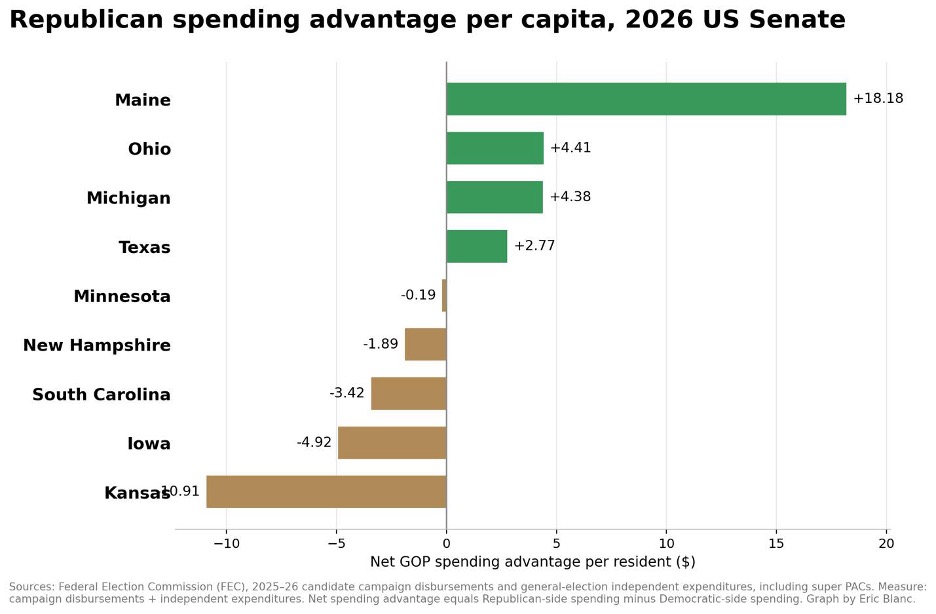
Chuck Schumer and the Democratic Senatorial Campaign Committee poured millions into establishment candidates who lost badly, while Angie Nixon received no comparable backing and nearly won in Florida. While centrist pundits like Matt Yglesias are claiming that leftists and populist candidates systematically underperformed compared to those they claim are “moderates,” any serious comparison of electoral performance has to take these disparities into account, as well as the genuinely anti-billionaire emphasis of candidates like Talarico.
And there’s a deeper strategic point here: our side has to run to win, but we also have to run to deliver big. That requires generally pushing for politicians prepared to enact ambitious reforms, like Zohran in New York City, even if taking some electoral risks is sometimes necessary in the process. So, while good campaigns have to read their local terrain and adjust accordingly, the biggest risk overall is staying with the same Democratic politics that got us into this mess in the first place.
6. AIPAC and Israel Suffered a Major Political Defeat
El-Sayed won despite extraordinary spending against him, including nearly $30 million from the American Israel Public Affairs Committee (AIPAC) during the Democratic primary. Talarico and similar Democrats also publicly rejected AIPAC money. The old assumption that Democratic candidates must obediently support Israel to remain electorally viable is crumbling, finally.
7. There’s a Growing Constituency for Taking On the Artificial Intelligence Oligarchs
Voters across the country backed ballot measures restricting or blocking data center development. Voters sided against data centers in forty-three of forty-four measures, including six decided earlier in the year. The billionaire owners of these companies were among the elites quickest to accommodate Trump; we need to make challenging their power a central part of our agenda.
8. This Election Was a Repudiation of Donald Trump, Not a Vindication of Chuck Schumer and Hakeem Jeffries
The same Democratic leaders who failed to mount a serious fight against Trump’s authoritarian offensive are now trying to claim credit for his defeat. Their political timidity, ties to the billionaires, and low ambitions make them profoundly unsuited for the fights ahead.
Democrats need new congressional leadership willing to confront Trump and champion transformative change. And the close races in supposedly unwinnable states should convince the party to stop writing off large parts of the country. Competing there consistently will require a bold program and much more organizing between elections.
9. The Democratic Party’s Future Is Unusually Fluid
The most significant thing about Haley Stevens’s disgraceful endorsement of Republican Mike Rogers is that much of the Democratic establishment continued backing El-Sayed, however reluctantly. Sections of Barack Obama’s political orbit are clearly trying to accommodate the Left.
The balance of power inside the Democratic Party is changing, and its future direction is up for grabs. Socialists should take advantage of every opening for cooperation while continuing to build independent strength.
10. We Need a New New Deal
Without having any illusions that Democrats on their own will do the right thing, we should also acknowledge that there are no timeless formulas for what comes next. Whatever clues we can find from history are most likely to be found in the 1930s.
Franklin Delano Roosevelt, like some of the smarter mainstream Democratic politicians around today, was fundamentally a political opportunist, but he could read which way the winds were blowing. The Great Depression, militant strikes, pressure from the Left, and the growing power of organized labor helped push his administration and a wing of establishment Democrats toward Social Security, the Wagner Act, and a more confrontational stance toward big business. Crucially, those transformational victories involved both independent working-class mobilization and alliances with reformers inside the Democratic Party.
The lessons of the 1930s can hardly be reduced to a rule against ever working with liberal Democrats. We need concrete analyses of concrete situations to assess which compromises are needed, which fights to pick, and which alliances to make or break. A new New Deal is possible and necessary. And winning it is the precondition for any further advance toward economic democracy.
11. Celebrating MAGA’s Defeat Is Not “Libbing Out”
Yesterday I saw plenty of joking from radicals online that it was ok for one night to “lib out,” i.e. celebrate Democratic wins against Republicans. The implication here is that there’s something not properly socialist about being excited about and engaged with such wins. But this misses something crucial: socialists should be unapologetically part of the broad fight against MAGA, including in electoral battles.
And contrary to what some far-left DSA leaders seem to believe, if Democrats now fail to deliver, the main beneficiary will likely be an emboldened far right. Our most immediate task is to organize enough independent working-class power to make the anti-MAGA (i.e., Democratic) coalition succeed in meeting workers’ urgent needs, rather than lob critiques from the sidelines about how betrayal and disappointment are inevitable.
12) The Biggest Danger Is Repeating the Disastrous Missed Opportunity of 2006–8
Like last night, anger at George W. Bush’s presidency propelled Democrats to congressional majorities in 2006, culminating in Obama’s historic landslide in 2008. Democrats had a huge mandate and large congressional majorities.
But Obama’s centrism and demobilization of his base squandered much of that opportunity. Millions who had hoped for fundamental change quickly grew disillusioned. Republicans won sixty-three House seats in 2010, and eight years after Obama’s first victory, Trump entered the White House.
The stakes today are even higher, and our crisis much deeper. Everything depends on breaking the destructive doom loop of Democratic victories, dashed hopes, and increasingly reactionary Republican comebacks. The good news is that the Democratic establishment is far more delegitimized than in 2008, and the Left is far stronger. History doesn’t have to repeat itself.
13) Congress Needs to Go on the Offensive Immediately
Ro Khanna got it right when he said on Election Day:
When we win, we need America’s next New Deal.
Medicare for All.
$25 living wage.
End the Iran War.
Zero aid [to] Israel.
Tax the billionaires.
Make Trump Hoover if he vetoes it.
Democrats should polarize the country around popular legislation that would materially improve people’s lives.
They should fight to repeal the roughly $900 billion in looming Medicaid cuts, protect Affordable Care Act affordability, and save threatened rural hospitals. They should redirect money from Immigration and Customs Enforcement and endless war toward jobs, health care, and public investment. And they need to start fighting now to end the filibuster — part of a wider fight against minoritarian veto points that will eventually have to tackle the Supreme Court, statehood for Puerto Rico and Washington, DC, and other long-needed democratic reforms. We can’t allow appeals to bipartisanship or institutional norms to become another excuse for suicidal inaction. It’s good to investigate and prosecute Trump, his goons, and his corrupt billionaire buddies, but the centerpiece of this Congress should be an ambitious economic agenda that makes the stakes of 2028 clear.
14. AOC Needs to Run for President in 2028
The victories of El-Sayed and other left populists show there’s a real path to winning the White House in 2028. No less important, without Alexandria Ocasio-Cortez in the race, an ambitious anti-billionaire agenda is far less likely to dominate the Democratic primaries.
There are genuine risks to running her for president, but the biggest risk is nominating another centrist without the determination or mandate to transform the country. Even if AOC loses the nomination, her campaign would generate massive grassroots power and help move the entire party toward a program capable of meeting this moment.
15. We Need Big Organizing
All of our organizations, from unions to Sunrise to Indivisible to DSA and beyond, have a historic opening for growth if we can pivot away from our routines, our online self-selection, and our excessively small goals. We have an opening for on-the-ground left organizing at an unprecedented scale in contemporary America.
By 2028, we need our unions to be on the offensive against corporations that bent the knee to Trump, and we need them to set the ambitious goal of organizing a million new workers every year under a new Democratic administration and forcing through labor law reform. DSA should aim to become a mass organization of at least half a million members, much more deeply rooted in the broader working class. That means moving beyond insular, self-marginalizing politics, turning instead to scaling up mass campaigns capable of involving our nonactivist neighbors, coworkers, and friends.
The obstacles ahead remain enormous: billionaires, corporate Democrats, a hostile Supreme Court, and a Republican Party determined to sabotage any transformative agenda. We need organized movements capable of forcing recalcitrant Democrats to fight, winning and defending reforms against elite resistance, and keeping up the pressure long after Election Day.
There’s still an enormous amount of work ahead. But after two years of darkness, we’ve won an extraordinary victory. The future is unwritten. Let’s make the most of it.
This article originally appeared in Jacobin, a democratic socialist magazine publishing long-form essays and analysis on politics, economics, and culture. Subscribe to the print edition for $20 a year.