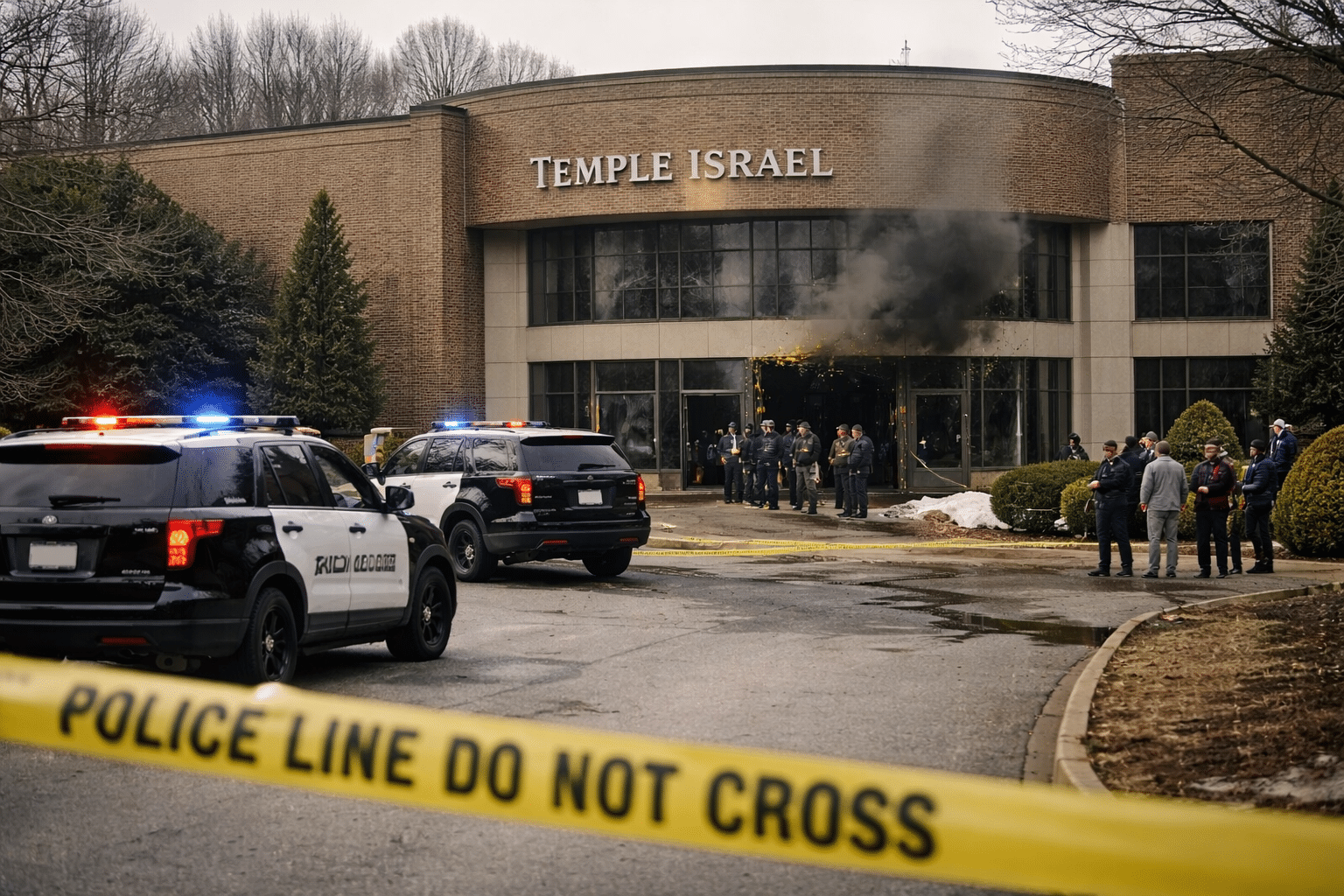
Federal authorities have identified the man who rammed a vehicle into Temple Israel and was later found dead inside it, as investigators work to determine why he attacked one of the nation’s largest Reform synagogues while children and staff were inside.
The Department of Homeland Security said the suspect was Ayman Mohamad Ghazali, 41, a naturalized U.S. citizen born in Lebanon. The FBI has taken the lead in the investigation and said the case is being treated as a targeted act of violence against the Jewish community, but officials have not announced a formal motive. The immediate stakes are no longer about finding a suspect. They are about reconstructing the attack minute by minute, determining what was in the vehicle, and explaining how a weekday school and synagogue session turned into a major federal crime scene without causing an even larger loss of life.
The public timeline begins shortly after noon on Thursday, March 12, when police were called to Temple Israel near Walnut Lake and Drake roads in West Bloomfield Township. West Bloomfield Police Chief Dale Young said officers were responding to what was first treated as an active shooter situation and arrived within minutes. By then, authorities said, the suspect had driven a vehicle through the synagogue’s doors and down a hallway. The vehicle then caught fire inside the building. Temple security officers confronted him and, in Young’s words, “neutralized the threat.” Oakland County Sheriff Mike Bouchard said the man was later found dead in the vehicle. One lead security officer was struck by the vehicle and knocked unconscious, but officials said his injuries were not life-threatening. No children, teachers or synagogue staff members were physically injured in the attack, even though a preschool and early childhood program were in session at the time.
Authorities have released only part of the picture of what happened inside the building. Bouchard said the vehicle breached the front of the synagogue and traveled down an interior hallway before stopping. Jennifer Runyan, the special agent in charge of the FBI’s Detroit field office, described the event as a “deeply disturbing and tragic incident” and said the FBI was leading the case because it was considered a targeted act against the Jewish community. Local reporting and national follow-up accounts said the suspect was armed, but by Friday afternoon officials still had not laid out a full public inventory of what was recovered from the vehicle or whether any explosive materials were confirmed by investigators. What is clear is that the fire and smoke complicated the response. Bouchard said 30 law enforcement officers were treated for smoke inhalation after rushing into and around the building as the scene unfolded.
The DHS identification added a new layer to the case because it answered questions about who the attacker was and how he came to be in the United States. DHS told CBS News that Ghazali lived in Dearborn Heights, came to the U.S. legally in 2011 on an immediate-relative immigrant visa after sponsorship from his then-wife, a U.S. citizen, and became a U.S. citizen in 2016. That information mattered because the early public discussion had focused on the attack itself rather than on the suspect’s background. But the immigration details did not answer the larger question investigators are still trying to resolve: what drove him to target a synagogue on a weekday afternoon. Sheriff Bouchard said Thursday that investigators still had to determine what “drove this person into action.” By Friday, that remained the central unresolved issue in the case, even as politicians and community leaders more broadly described the assault as antisemitic violence.
The scale of the danger inside Temple Israel became clearer as synagogue leaders and law enforcement described the setting. Authorities said the building housed an early childhood center, and about 140 children were on site when the vehicle entered the structure. AP reporting also said children as young as 4 and more than 30 staff members were inside. Cassi Cohen, the synagogue’s director of strategic development, said she was standing near the hallway where the crash happened when she heard a loud bang and understood immediately that something was badly wrong. Families were later reunited with children after officers repeatedly cleared the building. That sequence has become one of the story’s most important facts, because it explains both the urgency of the response and the fear that followed. The attack happened in a place designed for worship, education and routine family life, and it unfolded while parents believed they were leaving children in a protected environment.
Community reaction on Friday mixed relief with anger. Michigan Gov. Gretchen Whitmer visited West Bloomfield after being briefed on the investigation and publicly condemned the attack, saying the violence reflected hatred directed at a house of worship. Steven Ingber, the CEO of the Jewish Federation of Detroit, said after the attack that he wished he could say he was shocked, but could not, a statement that reflected how heavily security planning now shapes Jewish communal life. Temple Israel leaders and local reporting said recent security and active-shooter training helped staff move quickly. That point has become part of the public narrative not because it explains why the attack happened, but because it may help explain why no children were killed or seriously injured. The event has also led police departments in and around metro Detroit to increase patrols near Jewish institutions while the FBI continues reviewing evidence and collecting witness video.
Several pieces of the public record remain incomplete. Officials have not said exactly how the suspect died, whether from gunfire, the vehicle fire or both. They have not publicly released a detailed motive statement, a full ballistics account or a final description of everything recovered from the truck. They also have not explained whether the suspect had been on law enforcement radar before Thursday or whether he left behind writings, digital records or communications that could clarify intent. News organizations, including CBS, have reported information from community sources about recent deaths in Ghazali’s extended family during the war in Lebanon, but investigators have not adopted that as an official explanation for the attack. For now, the difference between public speculation and confirmed evidence remains important. Authorities have been more definite about what happened at the building than about why it happened.
The next phase of the case is likely to be less visible but just as important. The FBI said it deployed SWAT, negotiators, bomb technicians, evidence teams, victim services and cellular-analysis resources, drawing more than 100 agents and analysts into the response. That kind of footprint suggests the investigation is being treated as both a violent attack and a complex forensic case. Agents have asked the public to submit photos and video through the bureau’s digital tip line, a sign that investigators believe outside footage may help close gaps in the timeline. Because the suspect is dead, there is no criminal prosecution ahead against the alleged attacker himself. But there are still formal findings to make: the exact cause of death, the evidence recovered from the vehicle, the final motive determination and any federal conclusions about whether the attack meets the standard for a hate crime or domestic terrorism designation in public reporting. Those decisions will likely define how the case is remembered beyond the first burst of headlines.
For Temple Israel, the attack has already altered the ordinary meaning of a school day and a worship space. The scene left behind was both stark and strangely narrow: a vehicle driven through synagogue doors, smoke filling part of the building, a wounded security guard, dozens of officers treated for inhalation and families rushing to reclaim children who escaped unharmed. The larger physical toll was limited. The emotional one will not be. What happened in West Bloomfield was not only a law enforcement emergency. It was a direct assault on a place where children were learning and adults were working in the middle of an ordinary Thursday, and that is the fact likely to stay with the community long after investigators finish the evidence review.
As of Friday, March 13, the suspect had been identified by DHS, the FBI was leading the case, and officials still had not announced a confirmed motive. The next public milestone is expected to be a fuller investigative update explaining what was recovered from the vehicle, how the suspect died and what federal agents believe drove the attack.