In the past few weeks, New York City mayor Zohran Mamdani has proposed breaking up the Strategic Response Group and closing Rikers by 2032, the former established by progressive Mayor Bill de Blasio, who also revived a plan to dismantle the latter by 2027. But unfulfilled promises of police and carceral reform efforts go back to the 1990s. How much should the failures of previous mayoral administrations weigh on the decisions of Mamdani and his allies in regard to public safety and police?
This question has no easy answer. But a new book by James Barney on the tenure of New York City’s first black mayor, David Dinkins, offers insights on his efforts to rein in police excesses based on new research, especially in the local press of the era — and critically how those attempts failed, despite Mayor Dinkins’s desires and promises.
In A Fragile Alliance: David Dinkins, Coalition Politics, and the Struggle to Govern a City in Crisis, Barney, while sympathetic to Dinkins, argues that both Dinkins’s quiet leadership style and inability to create a narrative uniting his own multiracial coalition, much less the majority of the city, proved to be his undoing, dooming his reelection prospects and much of his agenda.
Barney, critical of identity politics throughout his history book, sums up his reservations here:
. . . in particular, Dinkins’s reliance on the mosaic metaphor betrayed a worldview that privileged difference. While Dinkins repeatedly noted that New York City was a “gorgeous mosaic,” in a “mosaic” each of the pieces is different. They only produce any meaning by being part of a larger piece of art. But this type of thinking was at the heart of Dinkins’s problems as a leader because it emphasized differences rather than commonalities.
Barney’s reservations about celebrating difference are at times too determinative. For instance, I doubt Dinkins could have done much to stop the disintegration of the New Deal/Great Society coalition that voted Democratic as white ethnics left the party across the country. But Barney’s concerns about the communication failures of Dinkins’s tenure were real and went beyond narrative to style.
While noble at times, the mayor’s quiet leadership style prevented New Yorkers — especially in a time without social media to get news rapidly and easily outside major media like Mamdani enjoys and uses today — from seeing their mayor’s interventions that created more peace than was seen elsewhere in America at the time, for example Los Angeles, which experienced a much deadlier upheaval triggered by the lack of convictions for the police who senselessly beat Rodney King, as well as the killing of teenager Latasha Harlins by a Korean American storeowner. This failure provided an opening to power for demagogues such as Rudy Giuliani to paint a darker picture around crime and disorder than actually existed.
While New York City’s political landscape has changed in many ways — the Staten Island secession movement, for example, is almost forgotten today — one thing Barney covers remains very much the same. The New York Police Department (NYPD) and institutions around it enjoy strong independence from civilian control that makes it difficult for any mayor to shape policy and personnel decisions commensurate with other major city agencies.
A famous instance of this was when the Sergeants Benevolent Association (SBA) tweeted out personal data of then-Mayor de Blasio’s daughter’s arrest related to the George Floyd uprising. Former SBA head Ed Mullins eventually faced disciplinary charges over this, though by then it was overshadowed by his federal indictment and conviction of stealing from his members. It is difficult to think of any other agency and its unions who would feel so emboldened to reject democratic oversight.
Dinkins, unlike most of today’s socialists and progressives, ran on a tough-on-crime agenda. He promised to hire thousands more police officers. The issue of crime polled high across racial and gender categories of voters. But Dinkins targeted his law-and-order proposals to include increasing policing in communities of color with officers of similar backgrounds. A major critic of this policy was Giuliani, who claimed this public safety policy would take police away from white neighborhoods. Giuliani’s racialized law-and-order rhetoric helped sink Dinkins.
Progressive mayors following Dinkins, such as de Blasio and Mamdani, have reckoned with the political reality that a public safety reform agenda is territory that isn’t worth attempting battle upon. And losing puts their whole left-wing agenda, not just public safety, at risk. Case in point: after Dinkins’s defeat, New York saw two decades of fiscal conservative and anti-police-reform mayors.
Crown Heights as a Turning Point
Two chapters of the book that expand on how such demagoguery on policing helped cost Dinkins his mayoralty focus on the Crown Heights riots and Patrolmen’s Benevolent Association (PBA) riots, respectively. These chapters also go beyond those two episodes of public violence to discuss how other instances of excessive police force neither led to uprisings nor successful efforts to advance civilian control of law enforcement. Barney’s research uses these events to help us understand how perceived disorder would be viewed as a key reason Dinkins lost, even though the crime rates were falling, and how his relationship with the police leadership and rank and file did not recover despite his own law-and-order narrative.
Dinkins won a surprise primary victory against three-term incumbent and bombastic erstwhile liberal Ed Koch in 1989. Barney credits Dinkins’s win through efforts to build a black-led, multiracial coalition out of the efforts in and around Jesse Jackson’s 1988 presidential campaign and subsequent Rainbow Coalition. Voter registration and mobilization, especially of black voters, to back Jackson were then used to elect Dinkins.
Those new voters proved fruitful for Dinkins’s own Rainbow Coalition. Dinkins won over half the vote in the multicandidate Democratic primary against Koch. But his candidacy against the Republican in the general was unusually closer. In New York, the Democratic Party primary more often than not is the de facto election. Not for Dinkins. He faced Giuliani, famous at the time for his federal prosecution of the mafia in New York’s Southern District, in 1989 and 1993. Each time, the victor only bested his opponent by around 2 points.
Not only were the margins similar, but Barney argues that themes in each election centered around crime, racial tension, and divisive ethnic politics. What made the difference was how a slim number of voters (turnout was roughly the same, 1.9 million in both mayoral races) eventually shifted toward a harsher response to perceptions of disorder, even as crime rates were declining.
Dinkins lost ground partly because of both the Crown Heights riot and PBA riot. Each contributed to the public perception of an ineffective Dinkins, which undermined his promises to create a safer city and less brutal policing methods.
The Crown Heights riot story officially begins on August 19, 1991, when a vehicle in a motorcade following the chief Lubavitcher (a sect of Jewish Hasidim) rabbi hit two Guyanese American children. The immediate lack of medical attention for the children by emergency medial technicians, explained by the Jewish volunteer service that initially responded to the accident lacking professional skills needed to treat the young people’s injuries, led to a retaliatory stabbing of a rabbinical student days later. The following unrest, in which 150 people were arrested and one hundred police injured, led the media to publicly question Dinkins’s ability to heal the racial and ethnic divide in the city and portray him as a weak leader.
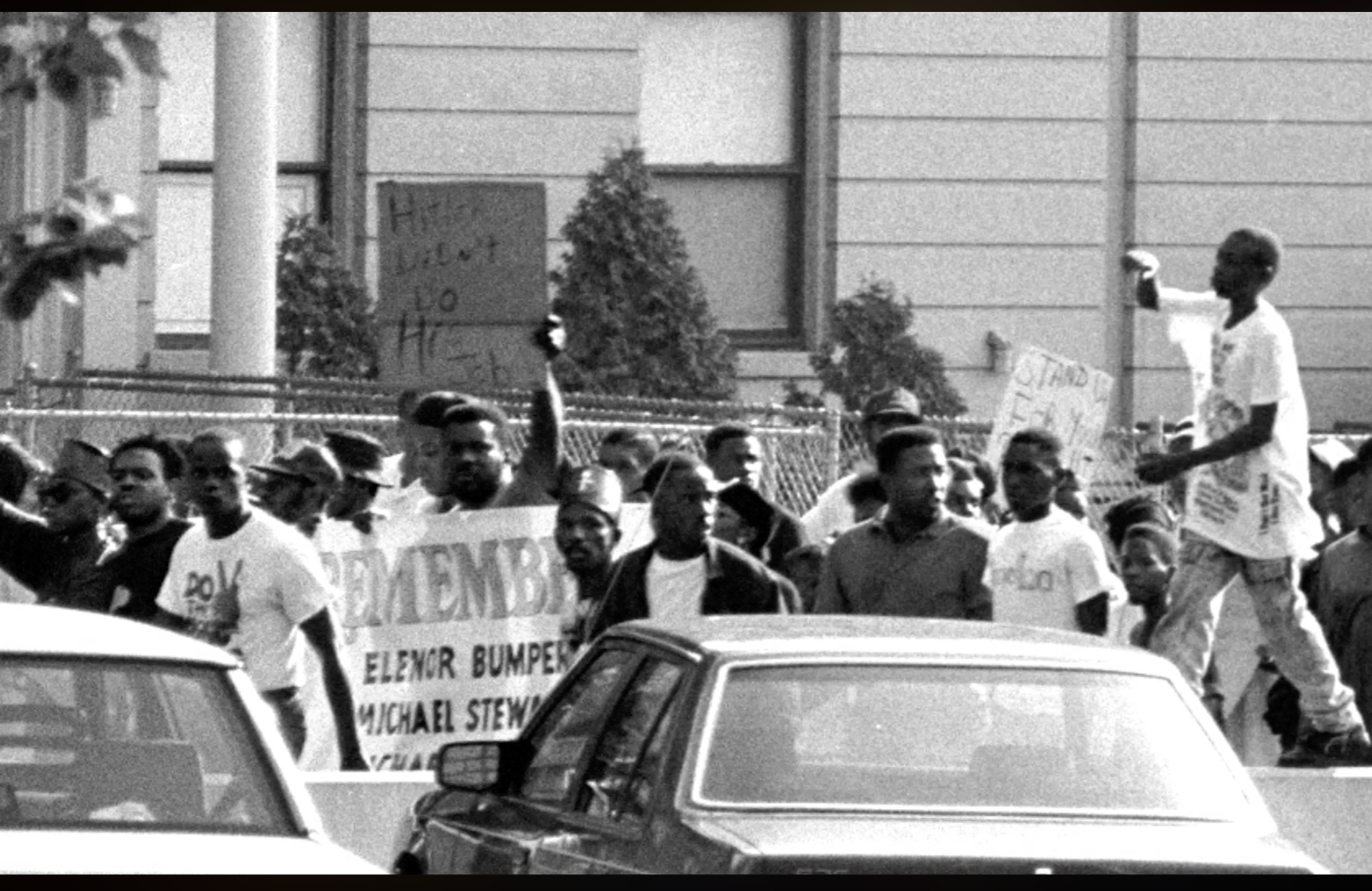
But the conflict in Crown Heights went further back than these two incidents. The riot itself reflected the tension between the religious Jewish enclave and their black neighbors, largely of West Indian descent. In a city where fights over resources can feel zero-sum, the well-organized and self-isolating Lubavitcher community appeared to gain at others’ expense. Their leadership, politically well-connected as a result of their well-organized followers voting as a bloc, primarily looked after their own. Barney notes, for example, that the police protection for the Lubavitcher headquarters was seen as taking officers away from the crack epidemic, fostering further estrangement from their black gentile neighbors.
Dinkins, viewing this as a battle of “good and evil,” according to Barney, responded to the restive state of Crown Heights by sending in a thousand police officers to quell the violence. Black civil rights leaders and organizers such as the Reverend Al Sharpton and Sonny Carson, at times previously allied with the mayor, turned on him. Sharpton even characterized Dinkins’s action as setting up an “apartheid state.”
But a second, seemingly contradictory viewpoint sprung up from Giuliani and his allies that Dinkins actually held the police back from acting. This narrative fit well with voters that Barney says wanted to lump Dinkins, Carson, and Sharpton together. Dinkins couldn’t win.
To make things worse, Dinkins publicly stated — repeating doctors’ misdiagnosis — that the stabbed rabbinical student would recover. But his wounds were fatal. The Jewish man died a few hours after Dinkins’s remarks. The death made Dinkins look, even if unfairly, incompetent.
Barney credits much of the success the mayor did achieve in facilitating conservations between different Crown Heights faith leaders. These dialogues between Christian and Jewish leaders were rarely reported in the press. To Barney, this was just another example of Dinkins’s “quiet leadership” that, while noble, undermined public perception of governance.
Ultimately, a 1993 internal city investigation called the Girgenti Report vindicated Dinkins from the viewpoint that he had not, in fact, held back the police nor abetted the prosecution of the rabbinical student’s killing. But the report’s timing was poor for the incumbent. Barney concludes it did more to remind voters in an election year of the chaos of two years earlier than absolving Dinkins in their eyes: “For a mayor who longed to unify, Crown Heights became the moment when broad segments of the public lost confidence in Dinkins and when his vision of a gorgeous mosaic, while laudable, was found insufficient to meet New York City’s realities.”
The narrative that Dinkins held the NYPD back in Crown Heights was one of many that undermined his relationship with the police department and its officers. Another was that the overwhelming white police force felt the mayor was giving preferential treatment to people of color and criminals.
The Police Riot as a Point of No Return
In 1992, a police officer shot a Dominican immigrant in Washington Heights, which sparked a series of events that led to a police riot by September. The Washington Heights shooting seemed to be heading toward similar unrest — this time, sparked by young people who felt overpoliced. Dinkins was able to de-escalate the situation well, such that even his critics like Cardinal John O’Connor gave the mayor credit for his handling of the shooting’s aftermath.
The mayor’s initial success and efforts included allies he recruited. Dinkins had an ally in Lee P. Brown, an African American criminologist and former police chief of Houston, Texas, that took the same role under Dinkins. As commissioner, Brown supported community policing, which brought more officers who looked like the people of the neighborhoods they patrolled. Again, this policy was not favored by some white people who felt it took resources from their residential areas.
But this balance between reform and political reality in policing became unstable for both Dinkins’s coalition and the NYPD brass. At the time, the police practiced stop and frisk, an invasive and violating search practice that nearly exclusively targeted young men of color. Dinkins would come to regret this policy. Beyond the ethics, stop and frisk also fostered a schism in his coalition between the young people who felt brutalized and the older residents who wanted more police. Roscoe C. Brown Jr, a Tuskegee airman veteran quoted by Barney, summed up this division in the simple fact that black people had been victims of both crime and racist policing. Solving one requires tackling the other.
But doing so for Dinkins became impossible. Brown resigned as commissioner in 1992, because, according to Barney, even this reformer did not want to go as far as Dinkins in empowering the police watchdog city agency, the Civil Complaint Review Board. Dinkins, unlike Brown, determined the NYPD was unable to hold itself accountable. Still, Brown’s departure was from the worst rebuke Dinkins would experience by the NYPD.
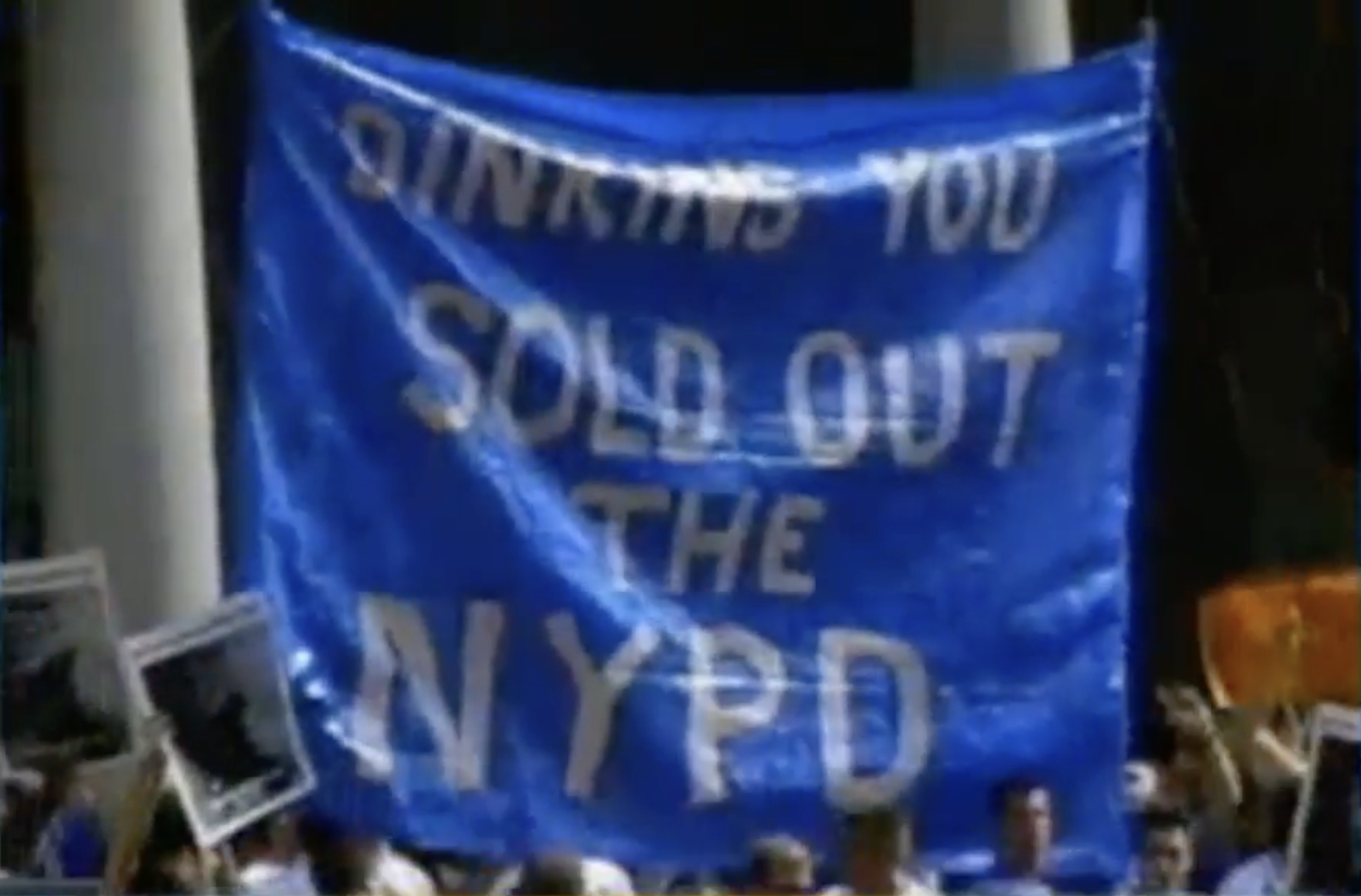
On September 16, 1992, organized by the police union (PBA), nearly ten thousand off-duty officers rallied outside city hall. Fueled by alcohol and rhetoric from Giuliani and PBA union leaders saying Dinkins favored criminals over cops, some police wore anti-Dinkins shirts, and others overturned barricades.
While the media and some allies like Sharpton returned to Dinkins’s camp after this because of the racist slurs hurled at Dinkins and noxious nature of the police riot, the damage was done with enough of the public. The perception that Dinkins had lost the police overrode the actual declining crime rates with a sufficient number of voters to eventually swing the election toward Giuliani the next year. This would end a progressive holding the mayor’s office until 2014 with the election of Bill de Blasio.
NYPD Reform Returns
Today not only is the mayor a progressive but, like Dinkins, a member of the Democratic Socialists of America (DSA). Zohran Mamdani also shares the challenges of balancing the wishes of his coalition and campaign promises with those of political reality. Policing is no different.
Recently, Mamdani has pledged to disband the Special Response Group (SRG), a controversial police unit with both counterterrorism and protest control duties, and also backed socialist councilmember Chi Ossé’s CURB Act, which would limit tactics employed by SRG. As the SRG’s responsibilities will be reassigned to other police units, a move reportedly supported by NYPD Commissioner Jessica Tisch, limiting existing practices that police reform advocates say they are most against is critical to the success of reform.
Unlike Commissioner Lee with Dinkins, Tisch was not the incumbent mayor’s appointment but a holdover from the previous mayor. Mamdani has resisted calls from parts of his coalition to fire her; these allies identify her support of Zionism and a strong carceral state as incompatible with a socialist vision. Except for not hiring nearly six hundred more police officers after pushback from NYC-DSA and others, the recent moves against SRG nearly a year into his term are a first real push to tackle unaccountable and abusive police power.
While New York City crime stands at record lows, the experience of Dinkins should serve as a warning that statistical realities such as declining rates are sometimes no match for scare tactics. The police still have soft and unchecked power, with council allies allegedly quietly opposing the CURB Act.
Hidden opposition can become public, and allies can return. But sometimes it is too late, as Dinkins experienced after the police riot. As the title of Barney’s book reminds us, holding power can be fragile. It will take a balance of principle and strategic planning to successfully rein in the police. Or else we will set back again.
A lesson the current mayor can also learn from Dinkins is in a communication style to avoid. Instead, he should continue to present an accessible vision and visible actions so voters and other members of the public can easily understand and repeat his policy priorities.
Had Dinkins been able to enjoy the social media platforms and fluency that Mamdani does to get around mainstream gatekeepers and parochial local press, he might have been able to overcome the idea he was ineffective. But even with such tools, it requires a willingness to be public, even boastful, which people adverse to demagoguery understandably avoid.
But good intentions can be fatal. Quiet leadership, while noble, may be silent even to your supporters. And it can be used against you by your enemies. The base needs to know what you’re doing to counter the inevitable lies and distortions thrown at left-wing politicians by their reactionary political opponents.
The success of a progressive and socialist public safety agenda depends on winning the majority. That requires a tremendous amount of organizing from the grassroots, but also political leaders who can help echo a narrative that can cut through the noise trying to maintain the status quo or reserve the gains made by reformers so far.
A Fragile Alliance is worth reading for anyone trying to comprehend how the past can weigh on today’s New York. It is a valuable resource in seeing how old attack frames, especially around identity, which seem outdated but once worked against Dinkins, could return against Mamdani. But more critically, how previous efforts of mayors around police reform failed and succeeded. Learning from that history can better prepare activists to push those in power, even our allied electeds, in a more strategic direction.
This article originally appeared in Jacobin, a democratic socialist magazine publishing long-form essays and analysis on politics, economics, and culture. Subscribe to the print edition for $20 a year.